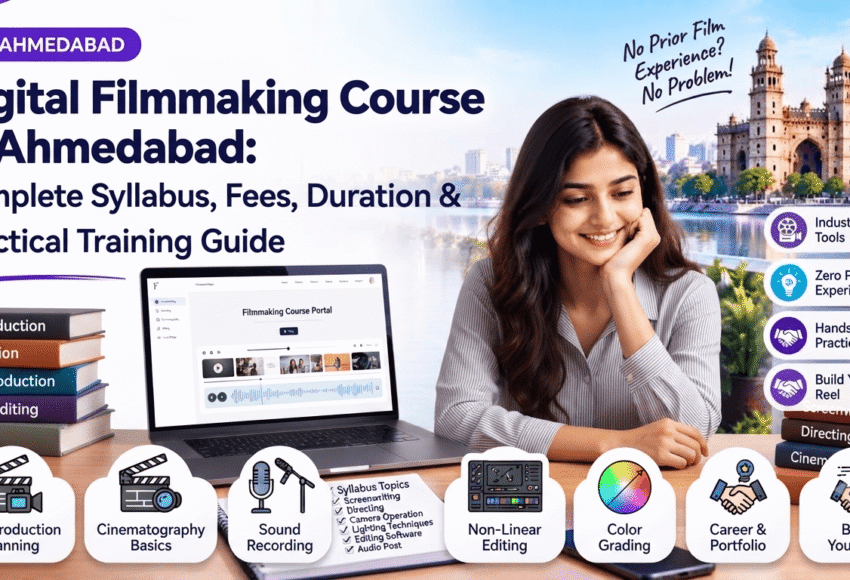
Digital Filmmaking Course in Ahmedabad, Complete Syllabus, Fees, Duration & Practical Training Guide
Digital content has changed the way stories are created, produced and distributed. From films and documentaries to advertisements, YouTube videos, OTT content, corporate films and social media campaigns, video has become an important form of communication.
For students and beginners interested in filmmaking, a Digital Filmmaking Course in Ahmedabad can provide structured training in storytelling, cinematography, camera operation, lighting, sound, editing, post-production and digital content creation.
However, choosing a filmmaking course is not only about learning how to operate a camera. A comprehensive program should teach the complete filmmaking workflow—from developing an idea to producing and editing the final video.
This guide explains the Digital Filmmaking course syllabus, duration, fees, practical training, software, projects, career opportunities and skills beginners should look for when comparing filmmaking courses in Ahmedabad.
Note: Course fees and duration vary between institutes depending on the syllabus, facilities, equipment, software, project work and certification. The fee ranges below are indicative and should be confirmed with the respective institute before admission.
What Is a Digital Filmmaking Course?
A Digital Filmmaking Course teaches students how to plan, produce, shoot and edit video content using modern digital production techniques.
A typical course may cover:
- Storytelling
- Scriptwriting
- Screenwriting
- Storyboarding
- Pre-production
- Cinematography
- Camera operation
- Lighting
- Sound recording
- Direction
- Video production
- Film editing
- Color correction
- Color grading
- Motion graphics
- Basic visual effects
- Digital distribution
The exact syllabus depends on the institute and specialization.
Why Study Digital Filmmaking in Ahmedabad?
Ahmedabad has an expanding ecosystem of businesses, advertising agencies, digital marketing companies, content creators, production teams and media professionals.
Students can potentially use filmmaking skills across different types of content, including:
- Short films
- YouTube videos
- Corporate videos
- Product videos
- Brand advertisements
- Social media videos
- Documentaries
- Music videos
- Educational content
- Event videos
- Promotional films
This makes digital filmmaking a broader skill area than traditional film production alone.
Digital Filmmaking Course Syllabus
A comprehensive filmmaking course should ideally cover the complete production process.
Storytelling and Idea Development
Every film begins with an idea.
Students learn how to convert an idea into a structured visual story.
Topics may include:
- Idea generation
- Story structure
- Character development
- Visual storytelling
- Narrative structure
- Scene development
- Story treatment
- Research
- Creative development
Practical exercise
Students can develop a short story idea and convert it into a basic treatment or concept document.
Scriptwriting and Screenwriting
A script provides the structure for production.
Students may learn:
- Script format
- Scene writing
- Dialogue
- Character development
- Scene description
- Screenplay structure
- Shot planning
- Script breakdown
Practical project
Write a short script for a 2–5 minute film or promotional video.
Storyboarding
Storyboarding helps filmmakers visualize the film before shooting.
Students can learn:
- Shot planning
- Camera angles
- Scene composition
- Character positioning
- Camera movement
- Visual sequence planning
A storyboard can help the director, cinematographer and production team understand what needs to be captured.
Pre-Production
Pre-production is the planning stage before filming begins.
Topics can include:
- Script breakdown
- Location planning
- Casting
- Crew planning
- Production schedule
- Shot list
- Equipment planning
- Budget planning
- Props
- Costume planning
- Location scouting
Practical exercise
Create a complete pre-production plan for a short video.
Cinematography
Cinematography focuses on how a story is visually captured.
Students can learn:
- Camera fundamentals
- Camera settings
- Exposure
- ISO
- Shutter speed
- Aperture
- Frame rate
- White balance
- Lens selection
- Composition
- Depth of field
- Camera angles
- Camera movements
Understanding these concepts helps students make deliberate visual decisions instead of relying only on automatic camera settings.
Camera Techniques
Practical camera training may include:
- Wide shots
- Medium shots
- Close-ups
- Extreme close-ups
- Over-the-shoulder shots
- Low-angle shots
- High-angle shots
- Tracking shots
- Pan
- Tilt
- Zoom
- Handheld shooting
- Stabilized camera movement
Students should ideally practice these techniques rather than only studying them theoretically.
Lighting for Filmmaking
Lighting has a major effect on the appearance and mood of a scene.
A filmmaking course may introduce:
- Natural lighting
- Artificial lighting
- Three-point lighting
- Key light
- Fill light
- Backlight
- Soft lighting
- Hard lighting
- Practical lights
- Mood lighting
- Lighting for interviews
- Product lighting
Practical exercise
Students can create the same scene using different lighting arrangements and compare the visual results.
Sound Recording and Audio Production
Good visuals are not enough if the audio quality is poor.
Students may learn:
- Microphone types
- Voice recording
- Dialogue recording
- Location sound
- Noise management
- Audio levels
- Sound effects
- Background music
- Voice-over
- Audio synchronization
- Basic sound editing
Basic audio knowledge is useful for filmmakers, video editors and content creators.
Direction
Directing involves converting the script into a visual production.
Students may learn:
- Working with actors
- Scene blocking
- Shot planning
- Camera coordination
- Directing performance
- Visual storytelling
- Production communication
- Managing scenes
Practical filmmaking projects are particularly useful for developing directing skills.
Video Production
Production is the stage where the planned film is actually captured.
Students can learn:
- Set preparation
- Camera setup
- Lighting setup
- Audio setup
- Scene blocking
- Shooting workflow
- Shot management
- Continuity
- Production coordination
A student project might involve producing a short advertisement, interview, documentary or short film.
Film and Video Editing
Editing transforms recorded footage into a structured story.
A digital filmmaking course may cover:
- Importing footage
- Organizing media
- Timeline editing
- Cutting
- Transitions
- Pacing
- Audio synchronization
- Titles
- Subtitles
- Basic effects
- Export settings
Common editing software may include:
- Adobe Premiere Pro
- DaVinci Resolve
- Final Cut Pro, depending on the training environment
Color Correction and Color Grading
Color correction helps create consistency between shots, while color grading can be used to establish a particular visual style.
Students may learn:
- Exposure correction
- White balance correction
- Color consistency
- Skin tone management
- Contrast
- Saturation
- Creative color looks
- Basic cinematic grading
Motion Graphics and Titles
Modern digital filmmaking often includes animated graphics.
Students may learn:
- Title design
- Lower thirds
- Logo animation
- Kinetic typography
- Intro and outro design
- Basic motion graphics
- Social media graphics
Tools may include Adobe After Effects or other motion graphics software.
Basic VFX and Compositing
Depending on the course, students may receive an introduction to:
- Green screen
- Chroma key
- Rotoscopy
- Tracking
- Masking
- Compositing
- Screen replacement
- Basic visual effects
These skills can help students expand from conventional editing into digital post-production.
AI Tools in Digital Filmmaking
Modern filmmaking workflows are also beginning to incorporate AI-assisted tools.
A contemporary filmmaking course may introduce students to AI for:
- Idea generation
- Story development
- Script brainstorming
- Storyboarding
- Concept visualization
- Image generation
- Video concept development
- Voice-over workflows
- Subtitle generation
- Editing assistance
- Creative research
AI should be treated as a supporting tool rather than a replacement for fundamental filmmaking skills.
A strong combination can be:
Storytelling + Cinematography + Editing + Motion Graphics + AI Tools
Digital Filmmaking Course Duration in Ahmedabad
The duration depends on the depth of the program.
| Course Type | Approximate Duration |
|---|---|
| Short-term filmmaking course | 2–3 months |
| Basic filmmaking course | 3–6 months |
| Professional filmmaking course | 6–12 months |
| Advanced filmmaking program | 12–18 months |
| Diploma-level multimedia/filmmaking program | 1–2 years |
Short-term courses are generally focused on specific skills, while longer programs can cover the complete production and post-production workflow.
Digital Filmmaking Course Fees in Ahmedabad
Fees vary considerably depending on the institute, course duration, equipment, software, faculty, facilities, certification and project work.
Indicative ranges may look like:
| Course Type | Indicative Fee Range |
|---|---|
| Short-term filmmaking training | ₹20,000–₹60,000+ |
| Basic filmmaking course | ₹30,000–₹1,00,000+ |
| Professional filmmaking course | ₹50,000–₹2,00,000+ |
| Advanced filmmaking program | ₹1,00,000–₹3,00,000+ |
| Comprehensive multimedia + filmmaking program | ₹80,000–₹3,00,000+ |
Always confirm the latest fees directly with the institute, because pricing can change based on curriculum, equipment, project requirements and certification.
What Practical Training Should a Filmmaking Course Include?
Practical training is one of the most important parts of filmmaking education.
Students should ideally work on multiple projects rather than only watching demonstrations.
Practical projects can include:
Short Film Project
Create a short narrative film from concept to final edit.
Advertisement Project
Create a promotional video for a fictional or real product.
Interview Project
Plan, shoot and edit a professional interview.
Documentary Project
Research a subject and produce a short documentary.
Music Video Project
Plan visuals, shoot footage and synchronize it with music.
Social Media Video
Create short-form content designed for platforms such as Instagram and YouTube.
Corporate Video
Create a professional company introduction or product video.
Digital Filmmaking Practical Workflow
A complete project can follow this workflow:
Idea
↓
Research
↓
Script
↓
Storyboard
↓
Pre-Production
↓
Location & Equipment Planning
↓
Shooting
↓
Footage Organization
↓
Video Editing
↓
Sound Editing
↓
Color Correction
↓
Motion Graphics/VFX
↓
Final Export
↓
Portfolio
This workflow helps students understand how the different parts of filmmaking connect.
Software Used in Digital Filmmaking
The exact software depends on the institute and course structure.
Common tools include:
| Area | Common Software |
|---|---|
| Video Editing | Adobe Premiere Pro, DaVinci Resolve |
| Motion Graphics | Adobe After Effects |
| Image Editing | Adobe Photoshop |
| Audio | Adobe Audition, DaVinci Fairlight |
| 3D | Blender, Autodesk Maya |
| Color Grading | DaVinci Resolve |
| Graphic Design | Adobe Illustrator, Photoshop |
| AI Creative Workflows | Various AI-based tools |
Students should focus on learning the underlying production concepts along with software.
Career Opportunities After a Digital Filmmaking Course
A filmmaking course can lead to different roles depending on specialization and experience.
Video Editor
Video editors assemble footage, synchronize audio, create transitions and shape the final story.
Cinematographer / Camera Professional
Camera professionals work on framing, camera operation, lenses, lighting and visual composition.
Assistant Director
Assistant directors help coordinate production activities and support the director during filming.
Content Creator
Content creators produce videos for platforms such as YouTube, Instagram and other digital channels.
Video Producer
Producers can be involved in planning, coordinating and managing video production.
Motion Graphics Designer
Motion graphics professionals create animated titles, graphics and visual elements.
Post-Production Professional
Post-production roles can include editing, color work, audio, compositing and visual effects.
Freelance Filmmaker
Freelancers can offer services such as:
- Video editing
- Corporate videos
- Product videos
- Social media videos
- Event videos
- YouTube editing
- Promotional films
- Motion graphics
Freelance income varies according to skills, portfolio, clients, project complexity and experience.
Who Can Join a Digital Filmmaking Course?
A filmmaking course can be suitable for:
- Students after 12th
- College students
- Graduates
- Working professionals
- Aspiring filmmakers
- YouTube creators
- Social media creators
- Video editors
- Digital marketers
- Content creators
- Freelancers
- Photography enthusiasts
Previous professional filmmaking experience is generally not required for beginner-level courses.
Skills You Should Develop Alongside Filmmaking
A strong filmmaker should develop more than technical software skills.
Important skills include:
Storytelling
Learn how to communicate an idea through visuals and sound.
Creativity
Develop original concepts and visual approaches.
Communication
Filmmaking involves collaboration with directors, actors, editors, designers, clients and production teams.
Observation
Good filmmakers pay attention to light, composition, movement, expressions and details.
Editing
Understanding editing helps filmmakers shoot footage with the final story in mind.
Problem Solving
Production rarely goes exactly according to plan. Filmmakers need to adapt to locations, lighting, equipment and scheduling challenges.
How to Build a Filmmaking Portfolio
A portfolio is important when applying for creative roles or freelance projects.
Instead of collecting random clips, create a focused portfolio.
A beginner portfolio could include:
- One short film
- One advertisement
- One interview
- One product video
- One social media video
- One motion graphics project
- One color-grading project
- One edited storytelling video
The portfolio should show your role in each project.
For example:
Project: Product Advertisement
Role: Concept + Shooting + Editing + Color Grading
This makes it easier for potential employers or clients to understand your capabilities.
How to Choose a Digital Filmmaking Institute in Ahmedabad
Before enrolling, compare the following factors.
Course syllabus
Check whether the syllabus covers both production and post-production.
Practical training
Ask how much time is spent actually shooting and editing projects.
Equipment
Find out whether students receive access to cameras, lights, microphones, tripods, stabilizers and other production equipment.
Software
Check which editing, motion graphics, audio and other creative tools are included.
Faculty
Look for trainers with relevant practical knowledge and production experience.
Projects
Ask how many individual projects students complete during the course.
Portfolio support
Check whether students receive feedback on their portfolio and showreel.
Certification
Understand who issues the certificate and what the certification represents.
Career support
Ask whether the institute provides:
- Resume assistance
- Portfolio review
- Interview preparation
- Job leads
- Employer connections
- Freelance guidance
Remember that job assistance and placement support are not the same as a guaranteed job.
Digital Filmmaking vs Video Editing
These two courses are related but have different focuses.
| Factor | Digital Filmmaking | Video Editing |
|---|---|---|
| Storytelling | Strong focus | Important |
| Camera | Strong focus | Basic/optional |
| Cinematography | Strong | Limited |
| Lighting | Strong | Limited |
| Sound Recording | Strong | Basic/post-production |
| Editing | Strong | Core focus |
| Production | Strong | Limited |
| Motion Graphics | May be included | Often included |
| VFX | Basic/optional | Basic/optional |
| Best suited for | Filmmaking & production | Editing & post-production |
If you want to work primarily behind the camera and understand production, filmmaking provides broader exposure.
If you mainly want to edit videos, a specialized video editing course may be more focused.
Digital Filmmaking Career Roadmap for Beginners
A beginner can follow this learning path:
Step 1: Learn storytelling
Understand ideas, scripts and visual storytelling.
Step 2: Learn camera fundamentals
Practice exposure, framing, lenses and camera movements.
Step 3: Learn lighting
Practice natural and artificial lighting setups.
Step 4: Learn sound
Understand microphones, recording and audio quality.
Step 5: Shoot small projects
Start with interviews, short videos and simple advertisements.
Step 6: Learn editing
Practice cutting, pacing, sound synchronization and transitions.
Step 7: Learn color
Practice correction and basic grading.
Step 8: Add motion graphics
Learn titles, lower thirds and simple animations.
Step 9: Explore AI tools
Use AI where it can improve research, ideation and creative workflows.
Step 10: Build your portfolio
Create several strong projects and a showreel.
Is Digital Filmmaking a Good Career Choice?
Digital filmmaking can lead to opportunities across traditional media and digital content.
The field includes:
- Film production
- Advertising
- YouTube
- OTT content
- Corporate communication
- Social media
- Digital marketing
- Education
- Events
- Product marketing
- Freelancing
However, completing a course alone does not guarantee employment. Practical ability, portfolio quality, communication, specialization and real project experience can all influence career opportunities.
Frequently Asked Questions
What is a Digital Filmmaking Course?
A Digital Filmmaking Course teaches the process of developing, shooting, editing and producing digital video content. It can include storytelling, scriptwriting, cinematography, lighting, sound, editing, color grading and post-production.
What is the duration of a Digital Filmmaking Course in Ahmedabad?
Depending on the program, duration can range from approximately 2 months to 2 years. Short-term courses focus on specific skills, while longer programs cover broader filmmaking and multimedia skills.
What are the fees for a Digital Filmmaking Course in Ahmedabad?
Indicative fees can range from approximately ₹20,000 to ₹3,00,000+, depending on course duration, syllabus, equipment, software, projects and institute.
Can I learn filmmaking after 12th?
Yes. Students can explore filmmaking, digital media, video production, animation and related creative courses after completing 12th.
Do I need a professional camera to learn filmmaking?
Professional equipment can be useful for advanced projects, but beginners can start learning composition, storytelling, lighting and editing with accessible equipment and gradually move to professional production equipment.
Which software is best for filmmaking?
There is no single software required for every filmmaking workflow. Adobe Premiere Pro, DaVinci Resolve and other professional tools are commonly used for editing and post-production, while additional software may be used for motion graphics, audio, VFX and 3D.
Can I become a video editor after a Digital Filmmaking Course?
Yes. Video editing is commonly included in filmmaking programs, although students who want to specialize specifically in editing may also consider a dedicated video editing course.
Can I freelance after completing a filmmaking course?
Yes. Depending on your skills and portfolio, you can offer services such as video editing, social media videos, corporate videos, product videos, event videos and promotional content.
Is AI included in modern filmmaking courses?
Some contemporary courses include AI-assisted creative workflows such as ideation, storyboarding, image generation, video concepts, voice-over and editing assistance. The exact AI tools and syllabus depend on the institute.
Does a filmmaking course guarantee a job?
No course should be assumed to guarantee employment. Career opportunities depend on practical skills, portfolio quality, specialization, experience, communication and employer requirements.
Conclusion
A Digital Filmmaking Course in Ahmedabad can help beginners develop skills across the complete video-production process—from storytelling and scriptwriting to cinematography, lighting, sound, shooting, editing, color grading and post-production.
When comparing filmmaking courses, do not look only at the course fee or duration. Check the syllabus, practical training, equipment access, software, faculty, project work, portfolio development and career support.
For students starting from zero, a practical learning path can be:
Storytelling → Camera → Lighting → Sound → Production → Editing → Color Grading → Motion Graphics → AI Tools → Portfolio
The strongest way to demonstrate filmmaking ability is through actual work. Build projects, create a professional showreel and continuously improve your visual storytelling skills.
If you are searching for a Digital Filmmaking Course in Ahmedabad, compare available programs based on your specific career goal—whether you want to become a filmmaker, video editor, content creator, cinematography professional, motion graphics designer or freelance video professional.