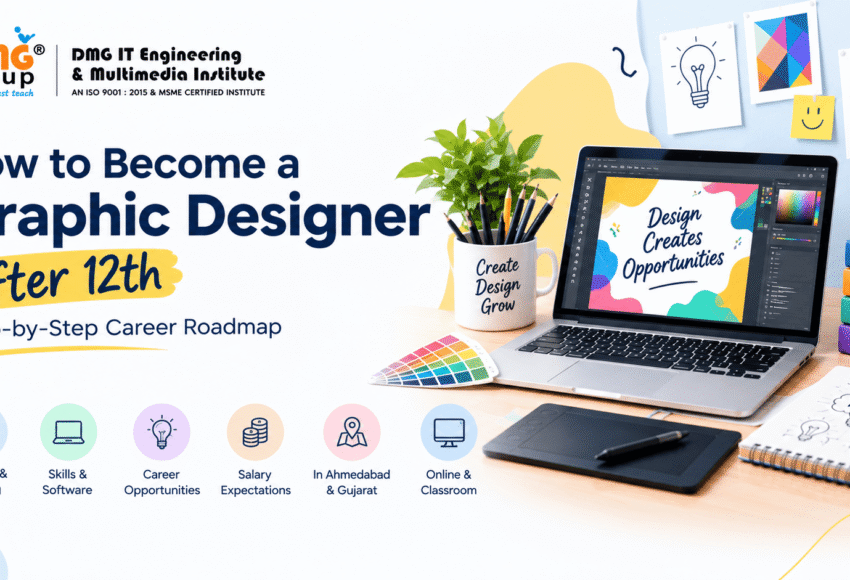
How to Become a Professional Graphic Designer After 12th: Step-by-Step Career Roadmap
Introduction
Are you a Class 12 student wondering what to do after school? If you are creative, enjoy working with colors, images, typography and technology, graphic design can be an exciting career option.
Today, graphic designers are needed across advertising, digital marketing, social media, e-commerce, branding, education, media, entertainment, technology and many other industries. Businesses need designers to create everything from logos and social media posts to advertisements, websites, packaging and brand identities.
The good news is that you do not necessarily need a traditional four-year degree to begin developing graphic design skills. After 12th, you can choose professional Graphic Design Training, a diploma or certificate program, a Graphic Design College, a specialized Graphic Design School, or an Online Graphic Design Course, depending on your goals.
In 2026, the career is also evolving with artificial intelligence. Students can now learn a combination of traditional design principles, professional software and AI-assisted creative workflows through a Graphic Design with AI Course.
This guide provides a step-by-step roadmap for becoming a professional graphic designer after 12th, particularly for students looking for opportunities in Ahmedabad and in Gujarat.
What Does a Graphic Designer Do?
Before choosing a career, it is important to understand what graphic designers actually do.
A graphic designer uses visual elements to communicate a message or solve a communication problem. The work can involve:
- Logo design
- Brand identity
- Social media posts
- Advertisements
- Brochures
- Posters
- Packaging
- Website graphics
- Presentations
- Digital banners
- YouTube thumbnails
- Marketing creatives
- Illustrations
- Print materials
- UI design elements
For example, a restaurant may need a designer to create its logo, menu, packaging and social media content. An e-commerce company may require product banners and advertisements. A startup may need a complete brand identity.
Therefore, graphic design is not simply about “making things look beautiful.” It is about communicating information visually and effectively.
Can You Become a Graphic Designer After 12th?
Yes, you can start learning graphic design after completing Class 12.
Students from different educational backgrounds can explore graphic design. You do not necessarily have to belong to an arts or design stream.
What matters more is your:
- Creativity
- Interest in visual communication
- Willingness to learn
- Ability to practice
- Understanding of design principles
- Software skills
- Portfolio
- Problem-solving ability
If you are comfortable learning technology and enjoy creative work, graphic design can be developed as a professional skill.
Step-by-Step Roadmap to Become a Graphic Designer After 12th
Step 1: Understand Whether Graphic Design Is Right for You
Before enrolling in a course, spend some time understanding the profession.
Ask yourself:
- Do I enjoy creative work?
- Do I like colors and visual layouts?
- Do I enjoy experimenting with images?
- Am I interested in branding and advertising?
- Can I sit and practice design for several hours?
- Am I willing to learn design software?
- Do I enjoy solving visual problems?
You do not need to answer “yes” to everything. However, genuine interest is important because becoming a good designer requires consistent practice.
Step 2: Learn the Fundamentals of Graphic Design
One of the biggest mistakes beginners make is starting with software without learning design fundamentals.
Software is a tool. Design thinking is the skill.
Start by learning:
Typography
Learn how fonts work, how to select appropriate typefaces and how to create text hierarchy.
Color Theory
Understand color combinations, contrast, palettes and how colors influence visual communication.
Composition
Learn how to arrange images, text and other elements within a design.
Visual Hierarchy
Understand how to guide the viewer’s attention from the most important element to supporting information.
Balance
Learn how visual elements can be arranged to create stability.
Contrast
Use differences in size, color, shape or typography to make important information stand out.
White Space
Empty space can improve readability and make a design look cleaner and more professional.
These fundamentals will remain useful regardless of which software or AI tools you use in the future.
Step 3: Learn Professional Graphic Design Software
After understanding the fundamentals, start learning industry-relevant software.
Depending on your career goals, you may learn:
Adobe Photoshop
Useful for:
- Photo editing
- Digital artwork
- Advertising creatives
- Image manipulation
- Social media designs
Adobe Illustrator
Useful for:
- Logo design
- Vector graphics
- Illustrations
- Icons
- Branding
Adobe InDesign
Useful for:
- Brochures
- Magazines
- Catalogues
- Books
- Multi-page layouts
Figma
Useful for:
- UI design
- Website design
- App interface design
- Digital prototypes
Canva
Canva can be useful for creating quick digital marketing and social media graphics, particularly for beginners and marketing professionals.
You do not need to master every application simultaneously. Start with the tools most relevant to your intended career path.
Step 4: Join the Right Graphic Design Course
Once you understand the basics, consider structured Graphic Design Training.
Students after 12th can explore several education formats.
Graphic Design College
A Graphic Design College or university-level program may provide broader academic education covering design theory, communication and related subjects.
This option may be appropriate for students looking for a longer academic qualification.
Graphic Design School
A Graphic Design School may focus heavily on creative concepts, visual communication, practical design and portfolio development.
Graphic Design Institute
A professional training institute may offer shorter, more focused programs designed around software skills, practical assignments and industry-oriented training.
There is no single option that is best for everyone.
The right choice depends on your:
- Career goal
- Budget
- Available time
- Preferred learning method
- Desired specialization
- Academic requirements
Step 5: How to Choose the Best Graphic Design Course in Ahmedabad
If you live in Ahmedabad and are searching for the Best Graphic Design Course in Ahmedabad, don’t choose a program only because it appears first in search results or has attractive advertisements.
Compare the following factors.
1. Curriculum
Check whether the syllabus covers:
- Design fundamentals
- Typography
- Color theory
- Photoshop
- Illustrator
- InDesign
- Digital design
- Branding
- Social media design
- Portfolio development
- AI tools
2. Practical Projects
A good course should provide practical assignments rather than only theoretical lessons.
3. Faculty
Check whether trainers have relevant practical experience and can provide useful design feedback.
4. Portfolio Support
Portfolio development should be an important part of your learning.
5. Learning Mode
Look for Online & Classroom options if you need flexibility.
6. Career Support
If your goal is employment, check what career support the institute actually provides.
7. Course Duration and Fees
Compare the total course duration, curriculum and facilities rather than selecting solely based on the lowest fee.
Step 6: Research the Top Graphic Design Institute in Ahmedabad
When students search for the Top Graphic Design Institute in Ahmedabad, they often find a long list of institutes.
Instead of blindly choosing one, create your own comparison.
Your List of Graphic Design Institute options can include:
| Factor | What You Should Compare |
|---|---|
| Course | Curriculum and specialization |
| Duration | Total learning period |
| Software | Tools included |
| AI | AI-assisted design training |
| Projects | Number and quality of practical projects |
| Faculty | Industry and teaching experience |
| Portfolio | Portfolio-building support |
| Mode | Online, classroom or hybrid |
| Certification | Type of certificate |
| Career Support | Internship/job assistance |
| Fees | Total course cost |
| Location | Accessibility if classroom-based |
This simple process can help you make a more informed decision.
Step 7: Practice Graphic Design Every Day
Joining a course is only the beginning.
If you want to become a professional designer, practice is essential.
Start with simple exercises.
For example:
Week 1
Practice typography and font combinations.
Week 2
Create different color palettes.
Week 3
Recreate simple social media designs for practice.
Week 4
Create posters.
Week 5
Design a fictional brand logo.
Week 6
Create a complete brand identity.
Week 7
Create a social media campaign.
Week 8
Create a small advertising campaign.
Do not simply copy other designers. Study existing designs to understand their structure and then create your own concepts.
Step 8: Build a Professional Graphic Design Portfolio
A portfolio is one of the most important things you will need when applying for graphic design jobs.
Instead of showing dozens of random designs, create a smaller collection of strong projects.
Your beginner portfolio could include:
- Logo design
- Brand identity
- Poster
- Social media campaign
- Advertisement
- Brochure
- Packaging design
- YouTube thumbnail
- Website/UI design
- AI-assisted creative project
For each project, explain:
- What was the objective?
- Who was the target audience?
- What was your concept?
- Which tools did you use?
- Why did you choose the colors and typography?
- How did you solve the design problem?
This demonstrates that you understand design thinking, not just software.
Step 9: Learn Graphic Design with AI
Artificial intelligence has become an important part of the creative industry.
A Graphic Design with AI Course can help students understand how AI can support different stages of the design process.
AI can assist with:
- Creative brainstorming
- Concept generation
- Image creation
- Image editing
- Background generation
- Image enhancement
- Creative variations
- Content adaptation
- Design workflow automation
However, AI should be viewed as a creative assistant rather than a complete replacement for a designer.
A professional still needs to understand:
- Branding
- Typography
- Composition
- Audience
- Visual hierarchy
- Client requirements
- Design strategy
Therefore, the ideal learning approach in 2026 is:
Graphic Design Fundamentals + Professional Software + AI Skills + Creativity + Portfolio
Step 10: Choose Your Graphic Design Specialization
After learning the basics, you can choose an area in which to specialize.
Branding Designer
Focuses on:
- Logos
- Brand identity
- Brand guidelines
- Visual systems
Social Media Designer
Creates:
- Instagram creatives
- Facebook posts
- LinkedIn graphics
- Social media campaigns
UI Designer
Focuses on:
- Websites
- Mobile applications
- Digital interfaces
- User interface systems
Packaging Designer
Works on:
- Product packaging
- Labels
- Product graphics
Motion Graphics Designer
Combines graphic design with animation and motion.
Advertising Designer
Creates visual assets for advertising and marketing campaigns.
Illustrator
Creates custom illustrations for digital and print applications.
Choosing a specialization can help you build a more focused portfolio.
Step 11: Get Your First Experience
After building your basic skills and portfolio, start gaining professional experience.
You can explore:
- Internships
- Junior graphic designer positions
- Design agencies
- Digital marketing agencies
- In-house design teams
- Freelance projects
- Remote opportunities
Do not wait until you feel “perfect.”
Your first internship or junior role can teach you things that classroom projects cannot, such as handling feedback, meeting deadlines and working according to client requirements.
Step 12: Start Freelancing
Freelancing can be another career path after developing sufficient skills.
You can offer services such as:
- Logo design
- Social media design
- Branding
- Poster design
- Brochure design
- Presentation design
- YouTube thumbnails
- Advertising creatives
- Packaging design
Start with smaller projects and gradually build your client base.
A professional freelance designer should also learn:
- Client communication
- Pricing
- Project management
- Invoicing
- Negotiation
- Revision management
- Time management
Graphic design becomes a stronger career when creative skills are combined with professional and business skills.
Graphic Designer Salary After 12th
Salary depends on several factors, including experience, portfolio, specialization, employer, location and technical skills.
As an illustrative career-planning range, an entry-level graphic designer may earn approximately ₹15,000–₹30,000 per month, while designers with several years of experience may earn significantly more.
A broad example could look like:
| Experience | Indicative Monthly Salary |
|---|---|
| Fresher | ₹15,000 – ₹30,000 |
| 1–3 years | ₹25,000 – ₹45,000 |
| 3–5 years | ₹40,000 – ₹70,000+ |
| Senior/Specialist | ₹60,000 – ₹1,00,000+ |
These figures are indicative, not guaranteed salaries. Actual compensation varies by company, skills, portfolio, specialization, experience and market conditions.
Freelance income can vary even more because it depends on project volume, pricing, client quality and specialization.
Is Graphic Design a Good Career in Ahmedabad and Gujarat?
Graphic design can be a suitable career for students who enjoy creative and digital work.
Businesses in Ahmedabad and across Gujarat can require designers for:
- Branding
- Digital marketing
- Social media
- Advertising
- E-commerce
- Packaging
- Corporate communication
- Website design
- Content creation
Students can also explore opportunities beyond Ahmedabad through remote work and freelancing.
However, simply completing a course does not guarantee a job. Your skills, portfolio, practical experience and ability to communicate professionally are important factors in career development.
Online Graphic Design Course vs Classroom Learning
Students after 12th may be confused about whether to choose an Online Graphic Design Course or classroom training.
Online Graphic Design Course
An online course can be useful for students who prefer:
- Flexible schedules
- Learning from home
- Remote access
- Self-paced learning
- Reduced travel
It may also be useful for students who cannot attend classes every day.
Classroom Graphic Design Training
Classroom learning can provide:
- Direct trainer interaction
- Immediate feedback
- Structured classes
- Peer learning
- Live demonstrations
- A fixed learning routine
Which One Should You Choose?
There is no universal answer.
If flexibility is your priority, online learning may suit you. If you are a beginner who needs regular trainer guidance, classroom learning may be more suitable.
If available, Online & Classroom learning options can provide additional flexibility.
1-Year Career Roadmap After 12th
Here is a simple roadmap that a beginner can follow.
Months 1–2: Fundamentals
Learn:
- Typography
- Color
- Composition
- Layout
- Visual hierarchy
Months 3–4: Software
Practice:
- Photoshop
- Illustrator
- InDesign
- Canva/Figma according to your goals
Months 5–6: Practical Design
Create:
- Posters
- Social media creatives
- Advertisements
- Logos
- Brochures
Months 7–8: Branding & Specialization
Choose an area such as:
- Branding
- Social media
- UI
- Illustration
- Packaging
- Advertising
Months 9–10: AI & Advanced Workflow
Learn how AI can support:
- Ideation
- Image generation
- Editing
- Creative variations
- Workflow efficiency
Months 11–12: Portfolio & Career
Focus on:
- Portfolio
- Resume
- LinkedIn profile
- Internship applications
- Job applications
- Freelance opportunities
- Interview preparation
This roadmap can be adjusted depending on whether you choose an intensive course, part-time training or an Online Graphic Design Course.
Common Mistakes Beginners Should Avoid
1. Learning Software Without Design Fundamentals
Knowing Photoshop does not automatically make someone a professional designer.
2. Copying Designs Without Understanding Them
Use references for learning, but develop your own design thinking.
3. Ignoring Portfolio Development
Employers and clients need to see what you can create.
4. Learning Too Many Tools at Once
Master a smaller set of relevant tools before adding more.
5. Ignoring AI
You don’t need to use every AI tool, but understanding modern AI-assisted workflows can be valuable.
6. Depending Completely on AI
AI-generated content still needs human creative direction, editing and quality control.
7. Not Learning Communication Skills
Designers need to understand and communicate with clients and teams.
8. Stopping After Completing the Course
Design trends, software and technology continuously evolve. Keep learning.
Frequently Asked Questions
1. Can I become a graphic designer after 12th?
Yes. Students can begin graphic design education after Class 12 through a college program, diploma, certificate course, institute-based training or online program.
2. Which is the Best Graphic Design Course in Ahmedabad?
The best course depends on your goals. Compare curriculum, practical projects, faculty, software, AI training, portfolio support, learning mode, duration, fees and career assistance before choosing.
3. Is a degree compulsory to become a graphic designer?
A degree can be useful for some career paths, but many design roles also place significant importance on practical skills and portfolio quality. Requirements vary between employers.
4. What should I learn first after 12th?
Start with design fundamentals such as typography, color, composition and visual hierarchy. Then learn relevant software and begin creating practical projects.
5. Is an Online Graphic Design Course suitable after 12th?
Yes. Online learning can be suitable if you are disciplined and the course provides structured training, practical assignments and feedback.
6. What is a Graphic Design with AI Course?
It combines traditional graphic design education with AI-assisted tools and workflows for ideation, image generation, editing and creative production.
7. What software should a beginner learn?
Photoshop and Illustrator are useful starting points for many graphic design careers. You can later add InDesign, Figma, Canva and other tools based on your specialization.
8. How long does it take to become a graphic designer?
Basic skills can be developed within a few months with consistent practice. Becoming job-ready depends on your learning pace, practical experience and portfolio quality.
9. What is the salary of a fresher graphic designer?
Entry-level salaries vary by company, city, portfolio and skills. An illustrative range is around ₹15,000–₹30,000 per month, but actual offers may be lower or higher.
10. Is graphic design a good career in Gujarat?
Graphic design can provide opportunities across advertising, digital marketing, branding, e-commerce, media and other industries in Gujarat. Career growth depends heavily on practical skills and portfolio quality.
11. Should I join a Graphic Design College or Graphic Design Institute?
Choose according to your career objective. A college may provide broader academic education, while an institute may offer focused practical training. Compare the actual curriculum and outcomes.
12. Can I become a freelance graphic designer after 12th?
You can start developing freelance skills after 12th, but it is better to first develop sufficient design knowledge, a strong portfolio and professional communication skills.
13. How do I find the Top Graphic Design Institute in Ahmedabad?
Create a List of Graphic Design Institute options and compare curriculum, faculty, practical projects, portfolio development, software, AI training, fees, duration and career support.
Conclusion
Becoming a professional graphic designer after 12th is not a one-step process. It is a journey that involves learning design fundamentals, mastering relevant software, practicing consistently, developing a portfolio, understanding AI-assisted workflows and gaining real-world experience.
For students in Ahmedabad and in Gujarat, there are multiple ways to begin, including a Graphic Design College, Graphic Design School, professional institute-based Graphic Design Training, or an Online Graphic Design Course.
When searching for the Best Graphic Design Course in Ahmedabad or comparing the Top Graphic Design Institute in Ahmedabad, focus on practical learning rather than simply choosing a course because of its certificate or advertising claims.
The graphic design industry is also evolving rapidly with AI. Learning a Graphic Design with AI Course alongside strong design fundamentals can help students understand modern creative workflows and prepare for changing industry requirements.
The most important formula for a successful career is simple:
Learn → Practice → Create → Build Portfolio → Gain Experience → Specialize → Keep Learning
If you are passionate about creativity and willing to practice consistently, starting your graphic design journey after 12th can be the first step toward a career in branding, advertising, social media design, UI design, illustration, motion graphics, digital marketing, freelancing and other creative fields.