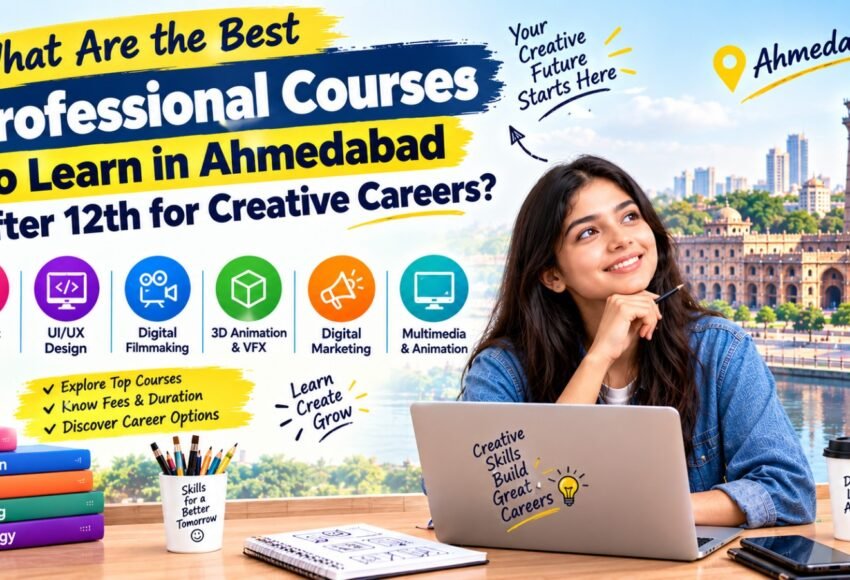
What Are the Best Professional Courses to Learn in Ahmedabad After 12th for Creative Careers?
Completing 12th is an important point for students deciding what to study next. While traditional degree programs remain an option, professional and skill-based courses can provide another route for students who want to develop specific career skills.
For students interested in creative careers, Ahmedabad offers opportunities to explore areas such as Graphic Design, UI/UX Design, Animation, Digital Filmmaking, Video Editing, Motion Graphics, Digital Marketing, and Web Design.
Each field requires a different combination of creativity, technology, communication, and problem-solving.
For example, a student who enjoys creating visual designs may find Graphic Design interesting. Someone fascinated by mobile apps and websites may prefer UI/UX. A student who enjoys storytelling through video may explore filmmaking and video editing.
This guide explains some of the professional creative courses students can consider after 12th, the skills they can learn, possible career directions, and how to choose an appropriate course in Ahmedabad.
Why Consider a Professional Course After 12th?
A professional course can help students focus on a specific skill area rather than spending years exploring unrelated subjects.
Depending on the program, students may gain:
- Industry-oriented skills
- Software knowledge
- Practical project experience
- Portfolio development
- Career-focused training
- Specialised knowledge
- Communication and presentation skills
However, a professional course should not be viewed simply as a shortcut to a job. Students still need regular practice, project experience, portfolio development, and continuous learning.
Best Creative Professional Courses After 12th in Ahmedabad
There is no single course that is suitable for every student. The following fields can help students understand different creative career directions.
1. Graphic Design Course
Graphic Design is one of the most versatile creative fields.
Students learn how to communicate ideas visually through:
- Typography
- Colour
- Layout
- Images
- Illustrations
- Branding
- Advertising
- Digital graphics
What Can Students Learn?
A comprehensive course may cover:
- Design fundamentals
- Colour theory
- Typography
- Composition
- Image editing
- Vector graphics
- Logo design
- Branding
- Social media design
- Poster design
- Advertising creatives
- Print design
- Digital design
Career Options
Students can explore roles such as:
- Graphic Designer
- Brand Designer
- Visual Designer
- Social Media Designer
- Advertising Designer
- Packaging Designer
- Publication Designer
- Freelance Designer
Suitable For
Graphic Design can be considered by students who enjoy:
Design + Creativity + Visual Communication
2. UI/UX Design Course
UI/UX Design focuses on digital experiences such as websites, mobile applications, and software products.
UI Means User Interface
UI design focuses on the visual aspects of a digital interface.
Students may learn:
- Layout
- Typography
- Colour
- Components
- Visual hierarchy
- Interface design
- Responsive design
UX Means User Experience
UX focuses on how users interact with a product and whether the experience is useful and easy to navigate.
Topics can include:
- User research
- User personas
- User journeys
- Information architecture
- Wireframing
- Prototyping
- Usability testing
Career Options
Possible roles include:
- UI Designer
- UX Designer
- Product Designer
- Visual Designer
- UX Research Assistant
Suitable For
UI/UX can be interesting for students who enjoy:
Design + Technology + Problem Solving
3. Multimedia Animation Course
Multimedia animation combines art, design, technology, storytelling, and movement.
Students can explore:
- 2D animation
- 3D animation
- Character design
- Motion graphics
- 3D modelling
- Texturing
- Lighting
- Rendering
- Compositing
- Visual effects
Career Options
Potential roles include:
- 2D Animator
- 3D Artist
- 3D Modelling Artist
- Character Animator
- Motion Graphics Designer
- VFX Artist
- Compositor
- Multimedia Designer
Suitable For
Animation may suit students who enjoy:
Storytelling + Characters + Motion + Visual Creativity
4. Digital Filmmaking Course
Digital filmmaking focuses on producing video content using modern digital production methods.
Students may learn:
- Storytelling
- Scriptwriting basics
- Storyboarding
- Cinematography
- Camera techniques
- Lighting
- Video production
- Video editing
- Sound
- Colour correction
- Post-production
Practical Projects
Students can create:
- Short films
- Advertisements
- Interviews
- Documentary-style videos
- Social media videos
- Promotional videos
- Music videos
Career Options
Potential roles include:
- Video Editor
- Videographer
- Video Production Assistant
- Content Creator
- Post-Production Artist
- Motion Graphics Designer
- Video Producer
Suitable For
Digital filmmaking may appeal to students who enjoy:
Storytelling + Camera + Video + Editing
5. Video Editing Course
Video editing is a specialised skill used across social media, advertising, entertainment, education, and corporate communication.
Students learn how to transform raw footage into structured video content.
Topics Can Include
- Cutting and sequencing
- Transitions
- Audio editing
- Colour correction
- Titles
- Motion graphics
- Visual effects
- Export settings
- Short-form video editing
Career Options
Students can explore:
- Video Editor
- Social Media Video Editor
- Content Editor
- Post-Production Assistant
- Freelance Video Editor
Suitable For
Video editing can suit students who enjoy:
Videos + Storytelling + Music + Creative Editing
6. Motion Graphics Course
Motion graphics combines graphic design with animation.
Instead of keeping a graphic static, motion graphics introduces movement.
Examples include:
- Animated text
- Logo animation
- Social media animations
- Explainer graphics
- Promotional videos
- Animated advertisements
- Presentation graphics
Career Options
Possible roles include:
- Motion Graphics Designer
- Multimedia Designer
- Visual Designer
- Video Content Designer
- Motion Designer
Suitable For
Motion graphics may be suitable for students who enjoy:
Graphic Design + Animation + Video
7. Digital Marketing Course
Digital Marketing is another career area where creative skills and technology overlap.
Students may learn:
- Search Engine Optimisation
- Social media marketing
- Content marketing
- Search advertising
- Social media advertising
- Email marketing
- Website basics
- Analytics
- Local SEO
- Content strategy
Modern digital marketing can also involve creative content production, including:
- Social media graphics
- Reels
- Videos
- Blog content
- Advertisements
- Campaign creatives
Career Options
Potential roles include:
- Digital Marketing Executive
- SEO Executive
- Social Media Executive
- Content Marketing Executive
- Digital Advertising Executive
- Performance Marketing Assistant
Suitable For
Digital Marketing can suit students who enjoy:
Creativity + Communication + Business + Technology
8. Web Design and Development
Students interested in both design and technology can explore website design and development.
Web Design Can Include
- Layout
- Typography
- Colour
- User interface
- Responsive design
- Website structure
Development Can Include
Depending on the course:
- HTML
- CSS
- JavaScript
- Content management systems
- Basic web development
Career Options
Potential roles include:
- Web Designer
- Front-End Developer
- UI Designer
- WordPress Designer
- Web Content Specialist
Suitable For
This field may suit students who enjoy:
Design + Websites + Technology
9. Graphic Design + UI/UX
Students who enjoy both traditional visual design and digital interfaces can consider learning these areas together.
Graphic design provides foundations in:
- Typography
- Colour
- Composition
- Visual hierarchy
- Branding
UI/UX adds:
- Wireframes
- User flows
- Prototypes
- Interface design
- Usability
This combination can be useful for students interested in digital design careers.
10. Graphic Design + Digital Marketing
Another useful combination is Graphic Design with Digital Marketing.
A student can learn to create:
- Social media posts
- Digital advertisements
- Website banners
- Marketing graphics
- Infographics
- Promotional videos
At the same time, digital marketing skills help students understand:
- Target audiences
- Content strategy
- Online campaigns
- Search visibility
- Social media
- Digital advertising
This combination can be particularly useful for students interested in creative marketing roles.
Course Comparison for Creative Careers
| Course | Main Focus | Creative Skills | Technical Skills | Possible Career Areas |
|---|---|---|---|---|
| Graphic Design | Visual communication | High | Medium | Design, branding, advertising |
| UI/UX | Digital experiences | High | Medium | Product and interface design |
| Animation | Motion and visual storytelling | High | High | Animation, VFX, multimedia |
| Digital Filmmaking | Video production | High | High | Film, media, content |
| Video Editing | Post-production | High | Medium/High | Video and digital content |
| Motion Graphics | Animated design | High | High | Advertising, media, content |
| Digital Marketing | Online marketing | Medium/High | Medium | Marketing, SEO, social media |
| Web Design | Websites and interfaces | Medium/High | Medium/High | Web and digital design |
This table is a general guide. Individual courses can combine multiple disciplines.
How to Choose the Right Course After 12th
Before choosing a course, students should first understand their interests.
Ask Yourself:
Do I enjoy visual design?
Consider Graphic Design.
Do I enjoy websites and apps?
Explore UI/UX or Web Design.
Do I enjoy animation and characters?
Consider Multimedia Animation.
Do I enjoy cameras and storytelling?
Explore Digital Filmmaking.
Do I enjoy editing videos?
Consider Video Editing.
Do I enjoy animated graphics?
Explore Motion Graphics.
Do I enjoy social media, communication, and marketing?
Consider Digital Marketing.
Course Duration After 12th
Professional course duration can vary considerably.
Some programs may be:
- Short-term certificate courses
- Several-month skill programs
- Diploma programs
- Longer professional programs
- Degree-level programs
The right duration depends on how deeply you want to study the subject.
A short course may introduce fundamentals, while a comprehensive program can provide more time for software practice, projects, specialisation, and portfolio development.
What About Course Fees?
Fees vary between courses and institutions.
The cost can depend on:
- Course duration
- Number of modules
- Software covered
- Practical projects
- Trainer experience
- Certification
- Portfolio support
- Classroom or online format
- Specialised subjects
Students should ask for the complete fee structure and check what is included before admission.
Rather than comparing price alone, compare:
Fee + Duration + Syllabus + Projects + Training + Portfolio + Certification
Why Practical Training Matters
Creative careers require more than theoretical knowledge.
Students should have opportunities to practise through projects.
For example:
Graphic Design
Create a complete brand identity.
UI/UX
Design a mobile application interface and clickable prototype.
Animation
Create a short character animation.
Filmmaking
Produce and edit a short video.
Video Editing
Create a promotional video from raw footage.
Digital Marketing
Develop a digital campaign with content and creative assets.
Projects provide students with material they can potentially use in their portfolios.
Build a Portfolio While You Learn
Students should not wait until the final month of their course to create a portfolio.
Start building it from the beginning.
Graphic Design Portfolio
Include:
- Logos
- Branding
- Posters
- Social media creatives
- Advertisements
- Packaging
UI/UX Portfolio
Include:
- User flows
- Wireframes
- Prototypes
- Mobile interfaces
- Website projects
Animation Portfolio
Include:
- Character animation
- 2D projects
- 3D models
- Motion graphics
- Short animated videos
Filmmaking Portfolio
Include:
- Short films
- Advertisements
- Video projects
- Editing samples
- Showreels
A focused portfolio can help demonstrate practical skills when applying for internships or entry-level opportunities.
Career Preparation After a Professional Course
Completing a course is only one part of career preparation.
Students should also work on:
Technical Skills
Learn the relevant software and workflows.
Creative Skills
Develop original ideas and visual problem-solving abilities.
Portfolio
Showcase your strongest projects.
Communication
Learn to explain your ideas and respond to feedback.
Professional Behaviour
Develop skills in:
- Time management
- Teamwork
- Meeting deadlines
- Understanding briefs
- Presenting work
Practical Exposure
Where available, internships, live projects, freelance assignments, and industry-oriented projects can provide additional experience.
Can Creative Courses Be Combined?
Yes. Combining complementary skills can create broader career possibilities.
Some examples include:
Graphic Design + UI/UX
For students interested in digital design.
Graphic Design + Digital Marketing
For creative marketing roles.
Animation + Video Editing
For multimedia and content production.
Filmmaking + Motion Graphics
For video and post-production work.
UI/UX + Web Design
For students interested in websites and digital products.
The combination should be based on your career goal rather than simply collecting certificates.
Common Mistakes Students Should Avoid
Choosing a Course Because It Is Popular
A popular course may not match your interests.
Focusing Only on Fees
Compare the complete learning structure rather than price alone.
Ignoring Practical Projects
Creative skills improve through regular practice.
Learning Too Many Tools at Once
It can be more useful to develop strong fundamentals and proficiency in relevant tools before expanding.
Neglecting Portfolio Development
Start documenting and improving your best work throughout the course.
Expecting Immediate Employment
A course provides training, but career development also requires practice, portfolio development, communication, and relevant experience.
How to Select a Professional Course in Ahmedabad
Before joining, check these points:
1. Course Syllabus
Is it current and relevant to your career goal?
2. Practical Training
How much time is spent actually creating projects?
3. Trainers
What professional and teaching experience do the trainers have?
4. Software
Which tools are taught?
5. Portfolio
Does the course include portfolio guidance?
6. Certification
What certificate or qualification is provided?
7. Duration
Is there enough time to learn and practise?
8. Learning Format
Are classes classroom-based, online, or hybrid?
9. Career Support
What exactly does the institute provide for career guidance or job assistance?
10. Student Projects
Can you review examples of previous student work?
A Simple Career Roadmap After 12th
12th Completed
↓
Identify Your Creative Interest
↓
Choose a Relevant Professional Course
↓
Learn Fundamentals
↓
Develop Software Skills
↓
Complete Practical Projects
↓
Build Portfolio / Showreel
↓
Develop Professional Skills
↓
Explore Internship / Entry-Level Opportunities
↓
Continue Specialisation and Learning
Frequently Asked Questions
1. Which professional course is best after 12th for creative students?
There is no single course that is suitable for every creative student. Graphic Design, UI/UX, Animation, Digital Filmmaking, Video Editing, Motion Graphics, Digital Marketing, and Web Design are some areas students can explore based on their interests.
2. Which creative courses are available in Ahmedabad after 12th?
Students can explore courses in Graphic Design, UI/UX Design, Multimedia Animation, Digital Filmmaking, Video Editing, Motion Graphics, Digital Marketing, Web Design, and related creative fields.
3. Can I learn graphic design after 12th?
Yes. Students can explore certificate, diploma, professional training, and degree-level programs depending on their educational goals and eligibility.
4. Is UI/UX a creative field?
Yes. UI/UX combines visual design, user research, problem-solving, information organisation, interaction design, and technology.
5. Do I need drawing skills for animation?
Drawing can be helpful for certain animation specialisations, particularly 2D and character animation. However, animation includes multiple areas, including 3D, motion graphics, modelling, compositing, and VFX.
6. Can I learn digital marketing after 12th?
Yes. Digital marketing can be studied through professional training programs, certificates, diplomas, and other educational routes depending on the provider.
7. Which course is suitable for students interested in filmmaking?
Students interested in storytelling, camera work, editing, production, and video can explore Digital Filmmaking, Video Editing, Motion Graphics, and Multimedia Animation.
8. Is a portfolio important for creative careers?
Yes. A portfolio can demonstrate your practical skills and creative thinking. It is particularly useful when applying for design, animation, video, and other creative roles.
9. How much do professional courses after 12th cost in Ahmedabad?
Fees vary based on the course, duration, syllabus, practical training, software, certification, and institution. Students should compare the complete course structure before enrolling.
10. Can I combine two creative courses?
Yes. Combining related skills such as Graphic Design + UI/UX, Graphic Design + Digital Marketing, or Animation + Video Editing can help students develop a broader skill set.
11. Are professional courses better than degree courses?
They serve different purposes. A degree generally provides a broader academic qualification, while a professional course may focus more specifically on particular career skills. Students should choose based on their educational and career objectives.
12. What should I check before joining a creative course?
Review the syllabus, practical training, software, trainer experience, projects, portfolio development, certification, course duration, fees, learning format, and career support.
Conclusion
Choosing a professional course after 12th is an important decision, particularly for students interested in creative careers. Ahmedabad students can explore a wide range of fields, including Graphic Design, UI/UX Design, Multimedia Animation, Digital Filmmaking, Video Editing, Motion Graphics, Digital Marketing, and Web Design.
Each field offers a different combination of creativity and technology. The right choice depends on what you enjoy creating and the type of career you want to explore.
Before enrolling, look beyond the course name and compare the syllabus, practical training, software skills, projects, portfolio development, certification, duration, fees, and career support.
Most importantly, start building practical work while you learn. A strong combination of:
Interest + Skills + Practice + Portfolio + Professional Development
can give students a solid foundation for exploring creative career opportunities after 12th.
Whether you want to design brands, create digital interfaces, animate characters, edit videos, produce films, create motion graphics, or develop digital marketing campaigns, choosing a focused learning path can help turn your creative interest into practical professional skills.