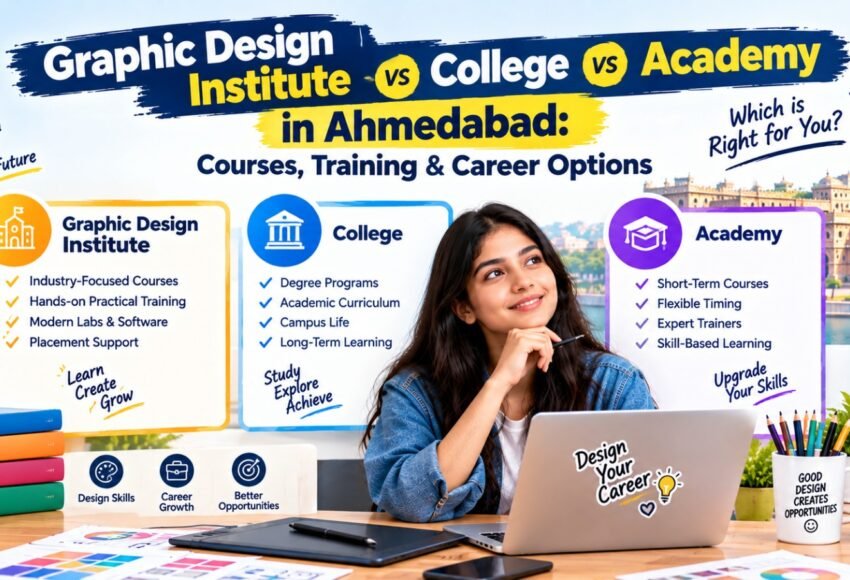
Graphic Design Institute vs College vs Academy in Ahmedabad: Courses, Training & Career Options
Graphic design has become an important skill across modern businesses and digital platforms. From logos and brand identities to social media creatives, advertisements, websites, packaging, presentations, and marketing campaigns, businesses need visual communication in many forms.
For students in Ahmedabad, there are different ways to learn graphic design. Some may consider a college degree, while others may prefer a specialised graphic design institute or academy.
But how are these options different?
A college, institute, and academy can vary considerably in their course duration, qualification, syllabus, practical training, software exposure, fees, flexibility, and career preparation.
Understanding these differences can help students select a learning path that matches their educational goals and creative interests.
What Is a Graphic Design College?
A graphic design college generally provides a structured academic program. Depending on the institution and program, students may study design alongside theoretical and general academic subjects.
A college-based graphic design education may include:
- Design fundamentals
- Drawing and visual communication
- Typography
- Colour theory
- Illustration
- Branding
- Advertising design
- Digital design
- Photography
- Web design fundamentals
- Portfolio development
- Design history and theory
The exact subjects depend on the specific program.
Who May Consider a College?
A college may suit students who want:
- A formal academic qualification
- A longer learning journey
- Broader academic exposure
- Structured semesters
- A recognised degree or diploma, depending on the program
- More extensive theoretical and practical education
Students should verify the exact qualification, accreditation, duration, and curriculum before enrolling.
What Is a Graphic Design Institute?
A graphic design institute generally focuses on professional skill development.
Rather than providing a broad academic education, many institutes structure their courses around practical design skills and industry software.
Training may include:
- Graphic design fundamentals
- Photoshop or image-editing skills
- Illustrator or vector design
- Typography
- Colour theory
- Logo design
- Branding
- Social media design
- Print design
- Digital advertising creatives
- Portfolio projects
Some institutes may also provide specialised modules such as UI design, motion graphics, video editing, or digital marketing.
Who May Consider an Institute?
An institute may be relevant for students who want:
- Skill-focused learning
- Practical software training
- A shorter or medium-duration program
- Portfolio-oriented assignments
- Career-focused training
- Flexible learning options
The actual experience varies between institutes, so students should evaluate the curriculum and project work rather than choosing based only on the course title.
What Is a Graphic Design Academy?
A graphic design academy generally refers to a training organisation that provides specialised education or professional development.
An academy may offer:
- Short-term graphic design courses
- Advanced design training
- Software-specific courses
- Branding workshops
- Portfolio programs
- Specialised design modules
- Practical assignments
- Professional development programs
The word “academy” does not automatically indicate a particular qualification or level of education. Students should check whether the program provides a certificate, diploma, degree, or simply a course-completion credential.
Graphic Design Institute vs College vs Academy
The following comparison provides a general understanding:
| Feature | Graphic Design College | Graphic Design Institute | Graphic Design Academy |
|---|---|---|---|
| Main Focus | Academic education | Skill-based training | Specialised training |
| Typical Duration | Longer | Short to medium | Short to medium |
| Qualification | Degree/diploma depending on program | Certificate/diploma depending on course | Certificate/diploma depending on course |
| Curriculum | Academic + practical | Practical + software-focused | Specialised + practical |
| Software Training | Depends on program | Often a major component | Often a major component |
| Portfolio | Usually developed during course | Often project-focused | May be strongly portfolio-oriented |
| Flexibility | Usually structured | Can vary | Can vary |
| Career Focus | Academic + career preparation | Professional skill development | Specialised career skills |
These are general distinctions. Individual institutions can have very different course structures.
Which Graphic Design Skills Should Students Learn?
Regardless of where you study, the fundamentals of graphic design should be part of the learning process.
1. Design Principles
Students should understand:
- Balance
- Contrast
- Alignment
- Hierarchy
- Proportion
- Repetition
- White space
- Composition
These principles help designers create visually organised work.
2. Typography
Typography is more than selecting an attractive font.
Students should learn:
- Font categories
- Font pairing
- Hierarchy
- Spacing
- Alignment
- Readability
- Typography for digital media
3. Colour Theory
Colour plays an important role in visual communication.
Students should understand:
- Colour relationships
- Contrast
- Colour harmony
- Brand colours
- Colour psychology
- Digital and print colour considerations
4. Image Editing
Image-editing skills are useful for:
- Social media creatives
- Advertisements
- Photo manipulation
- Posters
- Digital campaigns
- Marketing materials
5. Vector Design
Vector design skills can be used to create:
- Logos
- Icons
- Illustrations
- Brand assets
- Infographics
- Scalable graphics
Software Skills in Graphic Design Training
Modern graphic design training often includes professional design software.
Depending on the course, students may learn tools for:
- Image editing
- Vector graphics
- Page layout
- Illustration
- UI design
- Motion graphics
- Video editing
However, software should not become the entire focus of a course.
A student who knows how to operate software but does not understand composition, typography, colour, hierarchy, and visual communication may struggle to create effective designs.
Therefore, look for a course that combines design fundamentals + software + practical projects.
Practical Training: What Should Students Look For?
Practical training is particularly important in creative education.
Instead of completing only basic classroom exercises, students can benefit from projects that resemble real design requirements.
Useful Graphic Design Projects
Students can practise by creating:
- Logo concepts
- Brand identity
- Business cards
- Posters
- Brochures
- Social media campaigns
- Digital advertisements
- Product packaging
- Event creatives
- Infographics
- Presentation designs
- Website banners
Each project should have a purpose and target audience.
For example, instead of simply creating a poster, students could receive a brief such as:
“Create a promotional poster for a new educational course targeting college students in Ahmedabad.”
This encourages students to think about audience, messaging, hierarchy, layout, and visual communication.
Why Is a Graphic Design Portfolio Important?
A resume can tell an employer what you studied, but a portfolio can demonstrate what you can actually create.
A student portfolio can include:
- Logo designs
- Branding projects
- Social media creatives
- Posters
- Advertising campaigns
- Packaging concepts
- Editorial layouts
- Illustrations
- Digital banners
- UI design samples
Portfolio Tip
Do not simply upload finished images.
Where possible, explain:
Brief → Idea → Design Process → Final Output
This gives viewers a better understanding of your creative thinking.
Graphic Design Career Options in Ahmedabad
Graphic design skills can be applied across several industries.
Possible career roles include:
Graphic Designer
Creates visual communication for businesses, campaigns, publications, and digital platforms.
Brand Designer
Works on visual identity systems such as logos, colours, typography, and brand assets.
Social Media Designer
Creates visual content for social media campaigns and digital communication.
Visual Designer
Works on digital and visual experiences across different platforms.
Advertising Designer
Creates visual material for advertising campaigns.
Packaging Designer
Develops visual designs for product packaging.
Publication Designer
Works on magazines, brochures, books, reports, and other publications.
UI Designer
Uses visual design principles to create interfaces for websites and digital products.
Motion Graphics Designer
Creates animated visual content for videos, advertisements, presentations, and digital campaigns.
Freelance Graphic Designer
Works independently with businesses, agencies, creators, and other clients.
Graphic Design Career Options Beyond Design Agencies
Graphic designers can work in more than traditional design studios.
Potential work environments include:
- Advertising agencies
- Digital marketing agencies
- Branding agencies
- Media companies
- Publishing businesses
- E-commerce companies
- Corporate marketing departments
- Education companies
- Entertainment businesses
- Start-ups
- Freelance businesses
This makes graphic design a skill that can be combined with other fields.
For example:
Graphic Design + Digital Marketing
can be useful for professionals working on digital campaigns.
Similarly:
Graphic Design + UI/UX
can support students interested in digital product and interface design.
Graphic Design Course After 12th: Which Path Can Students Explore?
After completing 12th, students generally have several possible learning routes.
Route 1: Degree Program
Students can pursue a formal design-related degree through a college or university.
This can provide a longer academic learning experience.
Route 2: Diploma or Certificate Course
Students can choose a specialised program focused on graphic design skills and software.
Route 3: Professional Academy or Institute
Students can explore career-oriented training with practical projects and portfolio development.
Route 4: Combination Learning
Students can combine graphic design with another related skill such as:
- UI/UX
- Digital Marketing
- Video Editing
- Motion Graphics
- Animation
- Web Design
The appropriate route depends on the student’s educational goals, available time, budget, and desired career direction.
What About Fees?
Graphic design course fees in Ahmedabad can vary significantly.
The cost may depend on:
- Course duration
- Qualification
- Number of modules
- Software covered
- Practical training
- Trainer experience
- Portfolio support
- Certification
- Classroom or online format
- Advanced specialisations
Instead of comparing fees alone, students should compare what is included in the fee.
For example:
| Course Factor | Questions to Ask |
|---|---|
| Syllabus | What topics are covered? |
| Software | Which software will I learn? |
| Projects | How many practical projects are included? |
| Portfolio | Is portfolio development included? |
| Certification | What type of certificate is provided? |
| Training | How much hands-on practice is available? |
| Support | Is feedback provided on projects? |
| Duration | How long is the complete course? |
A lower fee does not necessarily mean fewer benefits, and a higher fee does not automatically mean better training. Students should compare the complete course structure.
Classroom vs Online Graphic Design Training
Students in Ahmedabad may also have the choice between classroom and online learning.
Classroom Training
Potential advantages include:
- Direct interaction with trainers
- In-person demonstrations
- Classroom discussions
- Immediate questions and feedback
- Structured learning environment
Online Training
Potential advantages include:
- Flexible schedule
- Learning from home
- Access to recorded lessons in some programs
- Reduced travel time
- Flexible revision
Hybrid Training
Some programs may combine online learning with classroom or practical sessions.
The important factor is whether students receive enough practice, feedback, guidance, and project-based learning.
How to Choose a Graphic Design Course in Ahmedabad
Before enrolling, use this checklist.
Check the Syllabus
Make sure the course covers fundamentals rather than only software tutorials.
Review Practical Projects
Ask to see examples of student projects if available.
Understand the Portfolio Process
Find out whether students receive guidance on building and presenting their portfolios.
Check Trainer Experience
Understand the trainer’s professional and teaching background.
Ask About Software
Confirm which software and versions are taught and whether practical access is provided.
Check Course Duration
Make sure the duration gives you enough time to practise.
Understand Certification
Ask what certificate or qualification you receive after completing the program.
Ask About Career Support
If an institute offers placement or job assistance, ask what exactly is included rather than assuming it means a guaranteed job.
Questions to Ask Before Joining a Graphic Design Course
Before paying the course fee, students can ask:
- What is included in the syllabus?
- Which software will I learn?
- How many practical projects will I complete?
- Will I create a professional portfolio?
- Will trainers review my projects?
- What certificate is provided?
- What is the total course duration?
- Are classes online, offline, or hybrid?
- Are study materials included?
- Is career guidance available?
- Are internships or live projects available?
- What additional costs should I expect?
Getting clear answers can make the course-selection process easier.
Common Mistakes Students Make
Choosing Only by Course Name
“Institute,” “academy,” and “college” are labels. The actual curriculum matters more.
Focusing Only on Software
Graphic design is not simply learning Photoshop or another application.
Ignoring Portfolio Development
Students should start building their portfolios during the learning process.
Selecting Only on Fees
Compare the complete learning experience before making a decision.
Expecting a Job Immediately
Completing a course is only one step. Skill development, portfolio quality, communication, and practical experience also matter.
Copying Designs
References are useful for learning, but students should develop original concepts and demonstrate their own creative thinking.
A Simple Graphic Design Learning Roadmap
Step 1: Learn Design Fundamentals
Start with composition, colour, typography, hierarchy, and visual communication.
Step 2: Learn Design Software
Develop practical skills with relevant design tools.
Step 3: Complete Practical Projects
Create posters, logos, social media designs, branding projects, and other assignments.
Step 4: Explore a Specialisation
Choose an area such as:
- Branding
- Social media design
- UI design
- Packaging
- Motion graphics
- Advertising
- Illustration
Step 5: Build a Portfolio
Select your strongest work and present it professionally.
Step 6: Develop Professional Skills
Work on communication, presentation, deadlines, teamwork, and receiving feedback.
Step 7: Explore Career Opportunities
Apply for internships, entry-level roles, freelance assignments, or other opportunities related to your skills.
Institute vs College vs Academy: What Should You Compare?
The name of the organisation should not be the only deciding factor.
Use this simple comparison checklist:
Education Goal
Do you need a degree or specialised skill training?
Time Available
Can you commit to a longer academic program, or do you need a shorter course?
Learning Style
Do you prefer academic theory, practical training, or a combination?
Career Direction
Do you want general design knowledge or a particular specialisation?
Portfolio Requirement
How much project-based work is included?
Budget
What is the total cost, including any additional expenses?
Certification
What qualification or certificate will you receive?
This approach allows students to compare options based on their own requirements.
FAQs
1. What is better for learning graphic design: college, institute, or academy?
There is no single option suitable for every student. A college may suit someone seeking formal academic education, while an institute or academy may suit someone looking for specialised and practical skill training.
2. Can I learn graphic design after 12th?
Yes. Students can explore degree, diploma, certificate, institute, and academy-based graphic design programs after 12th, depending on eligibility requirements.
3. Do graphic designers need a degree?
A degree can provide formal academic education, but graphic design careers can also be built through specialised training, practical skills, and a strong portfolio. Requirements vary by employer and role.
4. Which software should a graphic design student learn?
The software depends on the student’s career direction. Common areas include image editing, vector design, layout, illustration, UI design, motion graphics, and video editing.
5. How important is a portfolio for graphic design?
A portfolio is highly useful because it demonstrates a student’s design skills, creativity, problem-solving approach, and ability to complete practical projects.
6. Can I become a freelancer after a graphic design course?
Students can explore freelancing after developing sufficient design skills and creating a professional portfolio. Building client communication and project-management skills is also important.
7. How long does a graphic design course take?
Course duration varies depending on whether the program is a short-term certificate, diploma, specialised training program, or academic degree.
8. What should I check before joining a graphic design institute in Ahmedabad?
Check the syllabus, software training, practical projects, portfolio development, trainer experience, duration, certification, fees, learning format, and career support.
9. Can graphic design be combined with UI/UX?
Yes. Graphic design fundamentals can complement UI/UX learning, particularly in areas such as typography, colour, layout, visual hierarchy, and interface design.
10. Is graphic design useful for digital marketing?
Yes. Digital marketing campaigns frequently require visual content such as social media creatives, advertisements, banners, infographics, presentations, and branded content.
Conclusion
Choosing between a Graphic Design College, Institute, or Academy in Ahmedabad depends largely on what you want from your education.
A college may provide a formal academic pathway and longer-term education. An institute may offer focused professional training, while an academy may provide specialised or flexible learning options. However, these distinctions can vary between organisations, so students should always examine the actual program before enrolling.
For a career in graphic design, the most important areas to evaluate are design fundamentals, software skills, practical projects, portfolio development, trainer guidance, certification, and career preparation.
Whether you choose a college, institute, or academy, your learning should ultimately help you answer one important question:
“What can I create with the skills I have learned?”
A strong portfolio, practical experience, creative thinking, and continuous learning can help students prepare for opportunities across graphic design, branding, advertising, digital marketing, social media, UI design, publishing, packaging, motion graphics, and freelance work.
For students in Ahmedabad, comparing courses based on their career goals, learning requirements, practical exposure, and portfolio opportunities can make the course-selection process more informed and purposeful.