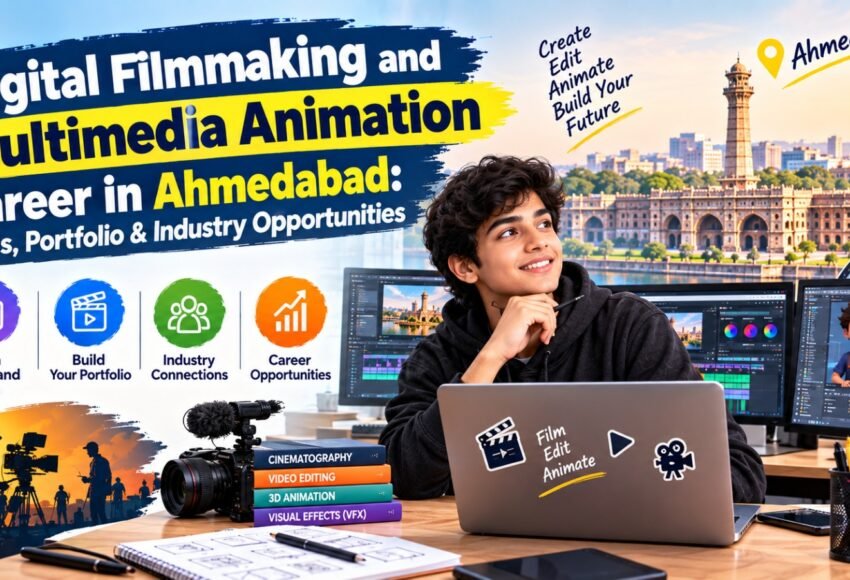
Digital Filmmaking and Multimedia Animation Career in Ahmedabad: Skills, Portfolio & Industry Opportunities
Digital filmmaking and multimedia animation have become important parts of modern creative communication. Films, advertisements, social media content, educational videos, brand campaigns, websites, games, and digital platforms all use some combination of video, animation, graphics, and visual storytelling.
For students in Ahmedabad, this field can provide an opportunity to combine creativity with technology. However, completing a course alone does not guarantee a career. Students should focus on developing practical skills, completing different types of projects, and creating a portfolio that clearly demonstrates their abilities.
This guide explains the skills to learn, portfolio projects to create, career options to explore, and industry areas where digital filmmaking and multimedia animation skills can be applied.
Digital Filmmaking and Multimedia Animation: Understanding the Field
Digital filmmaking refers to the process of planning, shooting, editing, and producing video content using digital technology.
It can include:
- Scriptwriting and storytelling
- Pre-production planning
- Camera and cinematography basics
- Lighting
- Video shooting
- Video editing
- Sound editing
- Colour correction
- Motion graphics
- Visual effects
- Digital content production
Multimedia animation focuses more on creating movement and visual experiences using graphics, illustrations, characters, objects, typography, and 2D or 3D environments.
It can include:
- 2D animation
- 3D animation
- Character animation
- Motion graphics
- 3D modelling
- Texturing
- Lighting
- Rendering
- Compositing
- Visual effects
The two fields often overlap. A modern video production may use animation, motion graphics, visual effects, editing, and live-action footage in the same project.
Why Choose a Career in Digital Filmmaking and Multimedia Animation?
Creative industries are increasingly dependent on visual content. Businesses, brands, educational organisations, entertainment companies, media platforms, and digital creators all use visual communication to reach audiences.
Students who enjoy creating videos, designing visuals, storytelling, animation, or experimenting with digital production can explore this career area.
Some potential advantages include:
1. Creative Work
The field provides opportunities to work with storytelling, visuals, characters, graphics, music, sound, and video.
2. Multiple Career Paths
Students do not have to follow only one career route. They can specialise in editing, animation, motion graphics, VFX, filmmaking, or multimedia design.
3. Portfolio-Based Careers
Creative professionals can demonstrate their capabilities through projects and showreels.
4. Freelancing Opportunities
After developing sufficient skills and experience, professionals may also work independently with businesses, agencies, creators, or production teams.
5. Cross-Industry Applications
Animation and filmmaking skills can be applied across advertising, education, entertainment, social media, corporate communication, gaming, and digital marketing.
Essential Skills for a Digital Filmmaking Career
Technical knowledge is only one part of filmmaking. A successful project also requires creative and communication skills.
1. Storytelling
A good filmmaker needs to understand how to communicate an idea through visuals.
Students should learn:
- Story structure
- Scene planning
- Visual storytelling
- Script basics
- Shot selection
- Audience understanding
2. Cinematography Basics
Understanding how cameras work helps students produce better footage.
Important concepts include:
- Camera angles
- Shot sizes
- Composition
- Framing
- Camera movement
- Lighting
- Exposure
3. Video Editing
Editing is one of the most important digital filmmaking skills.
Students should understand:
- Cutting and sequencing
- Transitions
- Audio synchronisation
- Pacing
- Colour correction
- Titles and graphics
- Export settings
4. Sound
Good visuals can lose their impact when the audio quality is poor.
Basic sound skills include:
- Voice recording
- Noise reduction
- Background music
- Sound effects
- Audio levels
- Dialogue editing
5. Colour and Visual Composition
Colour correction and visual composition help create consistency and mood throughout a video.
Essential Skills for Multimedia Animation
Animation requires a combination of artistic understanding and technical knowledge.
Core animation skills include:
- Drawing and visualisation
- Character design
- Storyboarding
- Timing and spacing
- Movement
- Composition
- Typography
- 2D animation
- 3D modelling
- Texturing
- Lighting
- Rendering
- Compositing
Students do not necessarily need to become experts in every area. Choosing a specialisation after learning the fundamentals can help create a focused career direction.
Software Skills Students Can Learn
The exact software used depends on the course and career specialisation.
Digital Filmmaking & Video Editing
Students may learn tools for:
- Video editing
- Colour correction
- Audio editing
- Motion graphics
- Visual effects
Animation
Depending on the learning path, students may work with software for:
- 2D animation
- 3D modelling
- Character animation
- Texturing
- Rendering
- Compositing
Graphic and Multimedia Design
Knowledge of image editing, vector graphics, typography, layout, and design tools can also support filmmaking and animation projects.
Important: Software knowledge should be combined with actual project work. Knowing the name of a software program is less useful than being able to use it to complete a professional-looking project.
Building a Strong Digital Filmmaking Portfolio
A portfolio is one of the most important career assets for a creative student.
Instead of simply listing software skills, students should demonstrate what they can create.
Portfolio Project Ideas
1. Short Film
Create a short story with:
- Script
- Storyboard
- Shooting
- Editing
- Sound
- Colour correction
2. Product Advertisement
Create a short promotional video for a fictional or real product.
3. Social Media Video
Produce a short vertical video designed for digital platforms.
4. Documentary-Style Video
Choose a local subject and create a short documentary using interviews, B-roll footage, narration, and editing.
5. Music Video
Create a short music-based visual project focusing on editing, rhythm, transitions, and storytelling.
Building a Multimedia Animation Portfolio
Animation students should demonstrate variety without making their portfolio unnecessarily large.
Useful project examples include:
1. 2D Character Animation
Create a short character movement sequence showing timing and expression.
2. Motion Graphics
Create animated typography, shapes, graphics, or promotional content.
3. Logo Animation
Develop a short animated identity reveal for a fictional brand.
4. 3D Product Animation
Create a simple 3D product model and animate it for a promotional video.
5. Short Animated Story
Develop a short narrative featuring characters, environments, animation, sound, and editing.
6. Visual Effects Project
Demonstrate compositing, background replacement, tracking, or other suitable VFX techniques.
What Makes a Good Creative Portfolio?
A portfolio should communicate three things:
What can you create?
How did you create it?
What skills did you use?
A strong student portfolio can include:
- 5–10 carefully selected projects
- Short project descriptions
- Before-and-after examples where useful
- Different creative formats
- Editing or animation breakdowns
- A showreel
- Contact information
- Relevant software skills
Quality is generally more useful than filling a portfolio with many unfinished projects.
Career Opportunities in Ahmedabad
Digital filmmaking and multimedia animation skills can be used in different types of creative and media-related work.
Possible roles include:
Digital Filmmaking Careers
- Video Editor
- Assistant Video Editor
- Video Production Assistant
- Content Video Editor
- Videographer
- Video Content Creator
- Motion Graphics Designer
- Post-Production Artist
- Visual Effects Artist
Multimedia Animation Careers
- 2D Animator
- 3D Artist
- 3D Modelling Artist
- Character Animator
- Motion Graphics Designer
- Multimedia Designer
- Compositor
- VFX Artist
- Animation Artist
- Visual Designer
Related Digital Careers
- Social Media Content Creator
- Creative Content Designer
- Digital Content Producer
- Multimedia Content Specialist
- Advertising Creative
- Freelance Video Editor
- Freelance Motion Designer
Job titles and responsibilities can vary between companies, so students should review individual job descriptions before applying.
Industries Where These Skills Can Be Used
Digital filmmaking and animation are not limited to film studios.
Students can explore opportunities across:
Advertising Agencies
Brands require video advertisements, promotional content, motion graphics, and social media creatives.
Digital Marketing Agencies
Digital campaigns frequently use short videos, animations, reels, product videos, and promotional content.
Media and Production
Production teams require editing, shooting, post-production, motion graphics, and visual effects skills.
Education and E-Learning
Educational organisations use animated explainers, training videos, presentations, and digital learning content.
Corporate Communication
Businesses use videos for training, internal communication, product demonstrations, and marketing.
Entertainment
Animation, video editing, visual effects, and post-production skills can support entertainment-related projects.
Social Media and Creator Economy
Content creators and brands need regular video editing, motion graphics, thumbnails, reels, and other visual content.
Digital Filmmaking vs Multimedia Animation Career Paths
| Area | Digital Filmmaking | Multimedia Animation |
|---|---|---|
| Main Focus | Video production and storytelling | Animation and digital visual creation |
| Key Skills | Shooting, editing, storytelling, sound | Animation, design, modelling, movement |
| Typical Projects | Short films, advertisements, documentaries | Animated videos, 2D/3D projects, motion graphics |
| Work Environment | Production, agencies, media, studios | Animation studios, agencies, media, design teams |
| Portfolio | Films, advertisements, showreels | Animation clips, motion graphics, 2D/3D projects |
| Freelancing | Video editing, shooting, content production | Animation, motion graphics, design, VFX |
There is also considerable overlap between the two. Learning both can be useful for students interested in broader multimedia production.
Is a Course Enough to Start a Career?
A course can provide structured learning, but career preparation requires more than classroom attendance.
Students should focus on:
- Learning the fundamentals.
- Practising regularly.
- Completing practical projects.
- Learning relevant software.
- Creating a portfolio.
- Building a showreel.
- Participating in internships or practical assignments where available.
- Understanding how professional projects are planned and delivered.
- Developing communication and teamwork skills.
- Continuously improving based on feedback.
The combination of skills + projects + portfolio + professional exposure can help students demonstrate their capabilities when applying for opportunities.
How to Choose a Digital Filmmaking & Animation Course in Ahmedabad
Before joining a course, students should compare the actual learning experience rather than choosing only by course name.
Check whether the course includes:
- Digital filmmaking fundamentals
- Video editing
- Storyboarding
- Cinematography basics
- Animation fundamentals
- Motion graphics
- 2D/3D concepts
- Practical assignments
- Portfolio development
- Showreel preparation
- Industry-oriented projects
- Trainer feedback
- Software practice
- Career guidance
Students should also ask whether projects are individual or group-based and how much hands-on practice is included.
Career Roadmap for Students
A simple learning roadmap can look like this:
Step 1: Learn the Fundamentals
Understand design, storytelling, composition, colour, typography, video, and animation basics.
Step 2: Learn Production Software
Choose software according to your preferred specialisation.
Step 3: Create Small Projects
Start with short videos, simple animations, motion graphics, or editing exercises.
Step 4: Select a Specialisation
You can explore:
- Video editing
- Filmmaking
- 2D animation
- 3D animation
- Motion graphics
- VFX
- Multimedia design
Step 5: Build Your Portfolio
Select your strongest projects and present them professionally.
Step 6: Create a Showreel
A short showreel can provide a quick overview of your creative and technical skills.
Step 7: Gain Practical Exposure
Internships, client projects, college projects, freelance assignments, and studio experience can help students understand real-world workflows.
Step 8: Apply for Relevant Roles
Search for opportunities that match your specialisation and portfolio.
Digital Filmmaking and Animation Career: Skills Employers May Look For
Employers may look beyond software knowledge when evaluating creative candidates.
Some commonly useful qualities include:
- Creativity
- Attention to detail
- Storytelling
- Visual understanding
- Editing ability
- Problem-solving
- Time management
- Communication
- Teamwork
- Adaptability
- Ability to accept feedback
- Portfolio quality
A candidate who can explain their creative decisions and demonstrate completed projects can communicate their abilities more effectively during an interview.
Common Mistakes Students Should Avoid
Only Learning Software
Software is a tool. Understanding storytelling, design, animation principles, and editing is equally important.
Creating Only Classroom Projects
Try to develop personal projects that show your own ideas and creativity.
Making the Portfolio Too Large
A portfolio containing many weak projects can make it harder to identify your strongest work.
Ignoring Audio
Sound quality can significantly affect the overall experience of a video.
Copying Existing Work
Use references for learning, but develop original concepts for your portfolio.
Not Updating Skills
Creative technology and production workflows continue to evolve, so ongoing learning is important.
Frequently Asked Questions
1. Is digital filmmaking a good career option after 12th?
Students interested in filmmaking, video production, editing, storytelling, and visual content can explore digital filmmaking after 12th. A structured course combined with practical projects can help build foundational skills.
2. What is the scope of multimedia animation in Ahmedabad?
Multimedia animation skills can be applied in advertising, digital marketing, media, education, entertainment, corporate communication, content creation, and other creative industries.
3. What should I include in an animation portfolio?
Include your strongest work, such as 2D animation, 3D modelling, motion graphics, character animation, logo animation, product animation, or short animated stories.
4. Do I need drawing skills to learn animation?
Basic drawing and visualisation skills can be useful, particularly for 2D and character animation. However, different animation specialisations have different requirements.
5. Can I become a video editor after learning digital filmmaking?
Yes. Video editing is one of the career areas students can explore after developing editing, storytelling, sound, colour, and post-production skills.
6. Can animation students work as freelancers?
Yes. Depending on their skills and experience, animation professionals may offer services such as motion graphics, video editing, 2D animation, 3D work, and visual content production to clients.
7. How long does it take to learn digital filmmaking and animation?
The duration depends on the course structure, specialisation, and learning depth. Short-term programs may focus on fundamentals, while comprehensive programs generally provide more time for software practice and portfolio projects.
8. Is a portfolio necessary for a filmmaking or animation job?
A portfolio or showreel is highly useful because it allows employers or clients to evaluate practical work rather than relying only on qualifications listed on a resume.
9. Which is better: filmmaking or animation?
They are different creative specialisations. Filmmaking focuses more on live-action production and storytelling, while animation focuses on creating movement and digital visuals. Students should choose based on their interests and the type of work they want to create.
10. Can I learn filmmaking and animation together?
Yes. The fields overlap in areas such as storytelling, editing, motion graphics, visual effects, sound, and post-production. Learning both can provide broader multimedia skills.
Conclusion
A career in digital filmmaking and multimedia animation in Ahmedabad can involve much more than learning video editing or animation software. Students need a combination of creative thinking, technical knowledge, storytelling, practical experience, and portfolio development.
The right learning path depends on individual interests. Students who enjoy cameras, storytelling, and editing may explore digital filmmaking, while those interested in characters, graphics, motion, 2D/3D visuals, or visual effects may prefer animation. Others can build broader multimedia skills by learning areas from both fields.
For students planning a creative career, the most useful approach is to learn the fundamentals, practise through real projects, build a focused portfolio, create a strong showreel, and continuously improve technical and creative skills.
Ahmedabad students can therefore explore digital filmmaking and multimedia animation as flexible creative fields with applications across media, advertising, digital marketing, education, entertainment, corporate communication, and content production.