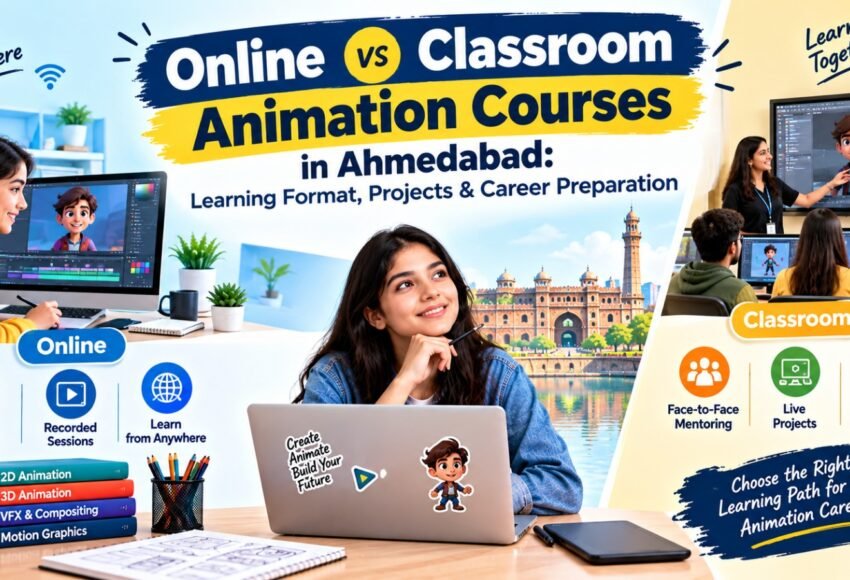
Online vs Classroom Animation Courses in Ahmedabad: Learning Format, Projects & Career Preparation
Animation is used across films, television, advertising, gaming, social media, education, digital content and other creative industries.
For students interested in this field, choosing the right learning format can be an important decision.
In Ahmedabad, learners can find both online and classroom Animation training options. Each format has its own advantages and challenges.
Online learning can provide flexibility, while classroom training can offer direct interaction and a more structured learning environment. However, the learning format alone does not determine the quality of an Animation course.
Students should also consider the syllabus, software training, practical projects, trainer feedback, portfolio development, course duration, fees and career preparation.
This guide compares online and classroom Animation courses in Ahmedabad to help students understand the differences before choosing a learning format.
Online vs Classroom Animation Courses in Ahmedabad
What Is an Animation Course?
An Animation course teaches students how to create movement, visual stories and animated content using design principles and digital tools.
Depending on the course, students may learn:
- Animation fundamentals
- Drawing and design basics
- Storyboarding
- Character design
- 2D Animation
- 3D Animation
- Motion graphics
- Video editing
- Visual effects
- 3D modelling
- Texturing
- Lighting
- Rendering
- Digital storytelling
The exact syllabus depends on the level and specialisation of the course.
Why Is Animation Training Popular in Ahmedabad?
Ahmedabad has a growing creative and digital ecosystem, including advertising agencies, design studios, media companies, production houses, marketing agencies and businesses producing digital content.
Animation and multimedia skills can be applied to:
- Advertising
- Social media
- Films
- Video content
- Gaming
- Education
- Corporate communication
- Branding
- Digital marketing
- Entertainment
This makes Animation a potential learning path for students interested in creative and digital careers.
Online Animation Course: How Does It Work?
An online Animation course allows students to learn remotely using a computer or laptop and an internet connection.
Depending on the institute, online training may include:
- Live classes
- Recorded lessons
- Online assignments
- Digital study materials
- Software demonstrations
- Online project reviews
- Trainer interaction
- Remote portfolio guidance
The exact learning experience varies between providers.
Advantages of Online Animation Training
1. Flexible Learning
Online classes can be convenient for students who have college, work or other responsibilities.
Where recorded sessions are available, learners may also be able to revisit lessons.
2. Learn From Home
Students do not need to travel to a training centre.
This can be useful for learners who live farther away or prefer remote education.
3. Flexible Schedule
Some online programs provide flexible schedules or recorded lessons.
This can make learning easier to fit around other commitments.
4. Access to Digital Resources
Online courses can provide digital assignments, tutorials, reference materials and project files.
5. Suitable for Working Professionals
Professionals who cannot attend regular classroom sessions may find online learning more convenient.
Challenges of Online Animation Training
Online learning also requires self-discipline.
Potential challenges include:
- Limited face-to-face interaction
- Delayed feedback in some courses
- Technical or internet problems
- Distractions at home
- Need for self-practice
- Difficulty maintaining a regular routine
For Animation, regular hands-on practice is particularly important because students need time to understand software and complete projects.
Classroom Animation Course: How Does It Work?
Classroom Animation training takes place at a physical institute or training centre.
Students attend scheduled sessions and learn directly from trainers.
A classroom course may include:
- Face-to-face lectures
- Software demonstrations
- Practical exercises
- In-class assignments
- Trainer feedback
- Group discussions
- Project guidance
- Portfolio development
Advantages of Classroom Animation Training
1. Direct Trainer Interaction
Students can ask questions and receive guidance during class.
This can be useful when learning complex software.
2. Structured Learning
Fixed class schedules can create a regular learning routine.
3. Immediate Practical Support
If a student faces difficulty while working on an assignment, the trainer may be able to address it during the session.
4. Peer Learning
Students can interact with classmates, exchange ideas and learn from each other’s projects.
5. Better Learning Routine
For learners who find self-paced education difficult, scheduled classroom sessions can provide additional structure.
Challenges of Classroom Animation Training
Classroom learning also has some limitations.
These may include:
- Fixed schedules
- Travel time
- Transportation costs
- Less flexibility
- Location restrictions
- Difficulty attending every class for working professionals
Therefore, students should consider their daily routine before selecting classroom training.
Online vs Classroom Animation Course: Comparison
| Factor | Online Animation Course | Classroom Animation Course |
|---|---|---|
| Learning location | Home or remote | Physical institute |
| Flexibility | Usually higher | Usually lower |
| Trainer interaction | Online | Face-to-face |
| Schedule | May be flexible | Usually fixed |
| Travel | Not required | Required |
| Peer interaction | Depends on course | Usually available |
| Practical work | Requires self-practice | Guided in class |
| Feedback | Online | Direct |
| Suitable for | Self-directed learners | Learners wanting structured guidance |
| Portfolio work | Possible | Possible |
| Career preparation | Depends on course | Depends on course |
The actual experience depends on the training provider and course structure.
Online vs Classroom: Which Is Better for Practical Projects?
Practical projects are essential in Animation training because students need to apply concepts through software and creative assignments.
Online Projects
Online students may complete projects remotely and submit them digitally for review.
This works well when the course provides:
- Clear project briefs
- Regular deadlines
- Trainer feedback
- Project reviews
- Portfolio guidance
Classroom Projects
Classroom students can work on projects while receiving in-person guidance.
They may be able to ask questions immediately when facing technical or creative difficulties.
Important Point
The quality of project guidance matters more than whether the course is online or offline.
A well-designed online course with regular feedback can be more useful than a classroom course with little practical work, and the reverse can also be true.
What Projects Should Animation Students Create?
A good Animation course should give students opportunities to build a portfolio.
Projects may include:
1. 2D Character Animation
Create a character and demonstrate movement, expressions and basic storytelling.
2. Motion Graphics
Create animated graphics for advertisements, social media or promotional videos.
3. Logo Animation
Create an animated version of a brand logo.
4. Short Animated Story
Develop a short visual story using characters, backgrounds, sound and animation.
5. Product Animation
Create an animated presentation for a product or service.
6. 3D Modelling Project
Design and model a simple 3D object or environment.
7. Video Editing Project
Combine animation, footage, sound, transitions and graphics into a finished video.
The projects should gradually become more complex as students develop their skills.
Animation Software Training
Animation requires practical software skills.
Depending on the course, students may learn tools for:
- 2D Animation
- 3D Modelling
- 3D Animation
- Motion Graphics
- Video Editing
- Compositing
- Illustration
- Digital Design
Students should ask the institute which software is included in the current syllabus.
More importantly, they should check whether they will actually use the software to complete projects, rather than only watch demonstrations.
Animation Course Duration in Ahmedabad
Course duration varies according to the level and specialisation.
Typical formats can include:
| Course Type | Approximate Duration |
|---|---|
| Animation Workshop | A few days to a few weeks |
| Short-Term Course | 1–3 months |
| Comprehensive Animation Course | 3–6 months |
| Advanced Animation Program | 6 months or more |
These are general ranges rather than fixed industry standards.
Students should compare the actual learning hours, project work, software training and syllabus instead of selecting a course based only on duration.
Animation Course Fees in Ahmedabad
Fees depend on several factors, including:
- Course duration
- Specialisation
- Number of software tools
- Practical projects
- Training format
- Trainer experience
- Portfolio support
- Certification
- Career assistance
Online programs may have different fee structures from classroom programs.
Before enrolling, ask for the complete fee structure and check whether it includes:
- Training
- Study materials
- Software guidance
- Assignments
- Projects
- Certification
- Portfolio development
- Career preparation
Fees can change between institutes and batches, so students should confirm current pricing directly.
Career Preparation After an Animation Course
Learning Animation is only one part of preparing for a career.
Students should also develop:
Technical Skills
- Animation software
- Editing
- Modelling
- Compositing
- Motion graphics
Creative Skills
- Visual storytelling
- Composition
- Character development
- Creativity
- Timing and movement
Professional Skills
- Communication
- Presentation
- Teamwork
- Time management
- Understanding project briefs
Portfolio Skills
Students should learn how to present their strongest work professionally.
Animation Portfolio: Why Is It Important?
A portfolio allows employers and clients to see what you can actually create.
A beginner portfolio may include:
- Character design
- 2D Animation
- Motion graphics
- Short animation
- Video editing
- 3D modelling
- Product animation
- Logo animation
Instead of including every assignment, students should gradually select their strongest projects.
A portfolio should demonstrate:
Creativity + Technical Skills + Storytelling + Problem Solving
Career Opportunities After Animation Training
After gaining relevant skills and building a portfolio, learners can explore different creative roles.
2D Animator
Creates two-dimensional animated content.
3D Animator
Creates movement and animation for three-dimensional characters and objects.
Motion Graphics Designer
Creates animated graphic content for advertisements, social media, videos and brands.
3D Artist
Works on modelling, texturing, lighting or other 3D production tasks.
Video Editor
Combines footage, animation, sound, graphics and effects into finished videos.
VFX Artist
Works with visual effects and compositing depending on their specialisation.
Character Designer
Creates visual concepts and designs for animated characters.
Multimedia Designer
Works across different digital visual formats.
Freelance Animator
Provides animation, motion graphics, video or multimedia services to clients.
Actual job requirements vary by company and role.
Online or Classroom: Which Format Should You Choose?
Instead of asking which format is universally better, consider your own learning requirements.
Choose Online Learning If You:
- Need flexible timings
- Prefer learning from home
- Are comfortable learning independently
- Have a busy college or work schedule
- Can maintain regular practice
- Have a suitable computer and internet connection
Consider Classroom Learning If You:
- Prefer face-to-face guidance
- Need a structured schedule
- Want immediate trainer interaction
- Prefer learning with other students
- Want guided practical sessions
- Find self-paced learning difficult
Consider a Hybrid Approach If Available
Some institutions may offer a combination of online resources and classroom interaction.
A hybrid model can potentially provide flexibility while retaining opportunities for direct guidance.
How to Choose an Animation Course in Ahmedabad
Before joining, use this checklist.
1. Check the Syllabus
Make sure the course covers the Animation specialisation you want to learn.
2. Ask About Software
Find out which tools are included and how much practical training is provided.
3. Check Project Work
Ask how many projects students complete.
4. Review Student Portfolios
If available, look at previous student work to understand the level of practical training.
5. Ask About Trainer Support
Find out how students receive feedback on their assignments.
6. Check Course Duration
Compare actual learning hours rather than duration alone.
7. Understand the Fees
Ask what is included and whether additional costs apply.
8. Check Career Support
Ask whether the institute provides resume guidance, portfolio preparation, interview preparation, internship support or job referrals.
9. Ask About Certification
Understand what certification is provided after completing the course.
Common Mistakes to Avoid
Choosing Only Based on Fees
The cheapest course may not provide the same project work or trainer support as another program.
Learning Software Without Fundamentals
Software skills are important, but Animation also requires storytelling, composition, timing and visual thinking.
Not Practising Regularly
Animation improves through consistent practice.
Building a Portfolio at the Last Minute
Start saving and improving your strongest projects throughout the course.
Choosing a Course Only Because It Is “Online”
Flexibility is useful, but students should also evaluate trainer support and project feedback.
Choosing Classroom Training Without Checking the Curriculum
Face-to-face classes do not automatically mean comprehensive training. Always review the syllabus and practical work.
Simple Animation Learning Roadmap
Step 1: Learn design and animation fundamentals
↓
Step 2: Select a specialisation
↓
Step 3: Learn the required software
↓
Step 4: Practise basic exercises
↓
Step 5: Create small projects
↓
Step 6: Learn advanced techniques
↓
Step 7: Complete portfolio projects
↓
Step 8: Create a professional portfolio
↓
Step 9: Prepare your resume
↓
Step 10: Practise presenting your work
↓
Step 11: Apply for internships or entry-level opportunities
FAQs
1. Which is better, an online or classroom Animation Course in Ahmedabad?
Neither format is universally better. The right option depends on your schedule, learning style, budget, need for trainer interaction and ability to practise independently.
2. Are online Animation courses useful for beginners?
Yes. Online learning can work for beginners when the course provides structured lessons, practical assignments, trainer feedback and portfolio support.
3. Is classroom Animation training better for practical learning?
Classroom training can provide direct guidance during practical sessions. However, the quality of project work and trainer feedback is more important than the format itself.
4. What is taught in an Animation Course in Ahmedabad?
Depending on the course, students may learn 2D Animation, 3D Animation, motion graphics, character design, storyboarding, video editing, visual effects, 3D modelling, texturing and related software.
5. How long does an Animation Course take?
Animation courses can range from a few weeks to several months depending on the syllabus, specialisation and level of training.
6. What are the fees for Animation Courses in Ahmedabad?
Fees vary according to course duration, software, practical projects, training format, certification and career support. Students should check the latest fee structure with the institute.
7. Can I do an Animation Course after 12th?
Yes. Students who have completed 12th can explore beginner-level Animation and Multimedia courses, depending on the eligibility criteria of the selected institute.
8. Do Animation students need drawing skills?
Basic drawing and visual observation can be helpful, especially for character design and traditional animation. However, the level of drawing skill required depends on the chosen specialisation.
9. Is a portfolio necessary for an Animation career?
A portfolio is highly useful because it demonstrates your practical skills and creative abilities to potential employers or clients.
10. What jobs can I get after an Animation Course?
Potential roles include 2D Animator, 3D Animator, Motion Graphics Designer, 3D Artist, Video Editor, VFX Artist, Character Designer and Multimedia Designer.
11. Can I learn Animation online and work as a freelancer?
Yes. Online learning can help you develop skills for freelance work, provided you practise regularly and build a strong portfolio.
12. How should I choose an Animation institute in Ahmedabad?
Compare the syllabus, software training, practical projects, trainer support, portfolio development, course duration, fees, certification and career assistance before enrolling.
Conclusion
Choosing between an online and classroom Animation Course in Ahmedabad depends largely on your personal learning requirements.
Online courses can provide flexibility, remote access and convenient scheduling, while classroom courses can provide face-to-face trainer interaction, structured learning and guided practical sessions.
However, the format should not be the only factor in your decision.
A good Animation course should provide a combination of strong fundamentals, software training, practical assignments, projects, trainer feedback, portfolio development and career preparation.
Before enrolling, compare the syllabus, fees, duration, learning hours, project opportunities, software coverage and career support.
Whether you choose online or classroom training, consistent practice and a strong portfolio can help you demonstrate your Animation skills when exploring internships, jobs or freelance opportunities.