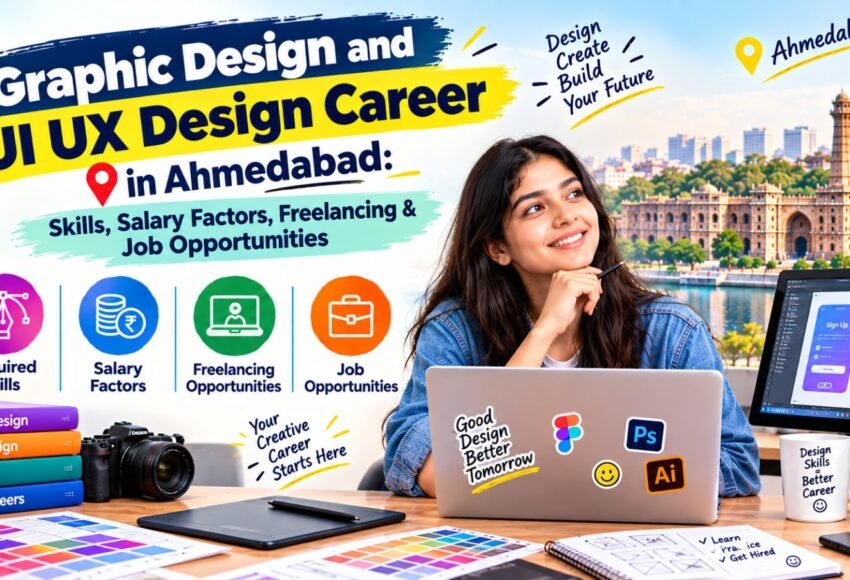
Graphic Design and UI UX Design Career in Ahmedabad, Skills, Salary Factors, Freelancing & Job Opportunities
Graphic Design and UI/UX Design are two popular options for students and professionals interested in creative and digital careers. Ahmedabad has opportunities across advertising, IT, startups, e-commerce, education, media, branding and other business sectors.
However, choosing between these fields requires understanding the difference between visual communication and digital product design.
Graphic Design is generally focused on creating visual content that communicates a message. UI/UX Design involves understanding users, planning digital experiences and designing interfaces that are clear and easy to use.
This guide explains the skills, career opportunities, salary factors, freelancing possibilities and preparation required for both career paths.
Graphic Design and UI UX Design Career in Ahmedabad
Introduction
The design industry has changed significantly with the growth of digital marketing, websites, mobile applications, social media and online businesses.
Businesses need attractive visual content to communicate with their audiences, while digital products need interfaces that are easy to understand and use.
This has created opportunities for different types of designers.
Two commonly explored career paths are:
- Graphic Design
- UI/UX Design
Although both involve creativity and visual design, they solve different problems.
Understanding these differences can help students, freshers and working professionals choose suitable training and career directions.
What Is Graphic Design?
Graphic Design is the process of communicating ideas and information through visual elements.
A Graphic Designer may create:
- Logos
- Brand identities
- Posters
- Brochures
- Social media posts
- Advertisements
- Banners
- Packaging designs
- Presentations
- Marketing creatives
- Website graphics
- Digital advertisements
Graphic Designers often work closely with marketing and communication teams.
For example, a digital marketing campaign may require a designer to create social media creatives, advertising banners and promotional graphics.
What Is UI/UX Design?
UI/UX Design focuses on designing digital products and experiences.
UI – User Interface
UI Design focuses on the visual appearance and interaction of a digital interface.
Examples include:
- Website screens
- Mobile app screens
- Buttons
- Navigation menus
- Forms
- Cards
- Design systems
- Dashboards
UX – User Experience
UX Design focuses on how users interact with a product and whether the experience is understandable, efficient and useful.
UX activities may include:
- User research
- User personas
- User journeys
- Information architecture
- Wireframing
- Prototyping
- Usability testing
- Problem identification
UI and UX are closely connected, although they involve different areas of the design process.
Graphic Design vs UI/UX Design
| Area | Graphic Design | UI/UX Design |
|---|---|---|
| Main Focus | Visual communication | Digital experience |
| Common Projects | Branding, advertising, social media | Websites, apps, dashboards |
| Main Objective | Communicate visually | Make digital products useful and understandable |
| Important Skills | Typography, colour, composition | UX research, wireframing, prototyping |
| Portfolio | Visual projects | Case studies and interface projects |
| Client Types | Brands, agencies, businesses | Startups, IT companies, product teams |
| Freelancing | Branding, social media, marketing design | Website, app and product design |
There is some overlap between the two fields, particularly in visual design and digital tools.
Essential Skills for a Graphic Design Career
A successful Graphic Design career requires more than learning software.
1. Design Fundamentals
Students should understand:
- Composition
- Colour theory
- Typography
- Visual hierarchy
- Balance
- Contrast
- Alignment
- Spacing
These fundamentals help designers create clear and professional designs.
2. Typography
Typography is especially important for branding, advertising and social media design.
Designers should understand font selection, hierarchy, readability, spacing and visual consistency.
3. Colour Theory
Colour can influence visual communication and brand identity.
A designer should understand colour combinations, contrast and how colours work across different design applications.
4. Image Editing
Image editing skills are useful for advertising, social media, marketing and branding projects.
5. Branding
Branding projects can help designers understand how logos, colours, typography and other visual elements work together.
6. Digital Design
Modern Graphic Designers may also create designs for:
- Websites
- Digital advertisements
- Email campaigns
- Online promotions
Essential Skills for a UI/UX Design Career
1. User Research
UX designers need to understand user requirements and problems.
Research may include interviews, surveys, competitor analysis and usability observations.
2. Wireframing
Wireframes help designers plan the structure of a website or application before developing detailed visual designs.
3. Prototyping
Interactive prototypes demonstrate how users may navigate through a digital product.
4. Information Architecture
Designers need to organise content and navigation so users can find information easily.
5. UI Design
UI skills include:
- Layout
- Typography
- Colour
- Components
- Buttons
- Forms
- Navigation
- Responsive design
6. Design Systems
A design system can help maintain consistency across multiple screens and products.
Software Skills for Graphic Design and UI/UX
The exact software used depends on the job and specialization.
Graphic Design Software Categories
- Vector design software
- Image editing software
- Page-layout software
- Presentation and visual-content tools
- Motion and video tools
UI/UX Software Categories
- Interface design tools
- Wireframing tools
- Prototyping tools
- Collaboration tools
- Research and documentation tools
Students should focus on design principles and practical application, rather than learning many tools without creating projects.
Graphic Design Job Opportunities in Ahmedabad
Graphic Designers can explore roles such as:
Graphic Designer
Creates visual communication materials for businesses and campaigns.
Brand Designer
Works on logos, brand identity and visual systems.
Social Media Designer
Creates digital creatives for social media campaigns.
Visual Designer
Works on digital and visual communication projects.
Marketing Designer
Creates designs for marketing campaigns and promotions.
Packaging Designer
Works on product packaging and related visual elements.
Creative Designer
Works on a broader range of creative communication projects.
Freelance Graphic Designer
Works directly with clients or through freelance platforms.
UI/UX Job Opportunities in Ahmedabad
UI/UX professionals can explore roles such as:
UI Designer
Focuses on the visual design of digital interfaces.
UX Designer
Works on user needs, research, information architecture and experiences.
UI/UX Designer
Combines interface design with UX processes.
Product Designer
Works on digital products from problem identification through interface and experience design.
UX Researcher
Focuses primarily on understanding users and their needs.
Interaction Designer
Focuses on how users interact with digital products.
Design System Designer
Works on reusable components and consistent digital interfaces.
Industries Hiring Designers
Design skills can be applied across many industries in Ahmedabad and beyond.
Potential sectors include:
- IT and software
- Advertising
- Digital marketing
- E-commerce
- Education
- Healthcare
- Real estate
- Retail
- Media
- Manufacturing
- Startups
- Branding agencies
- Entertainment
The exact roles available depend on the employer’s business model and design requirements.
Salary Factors for Graphic Designers in Ahmedabad
Instead of looking at salary as a fixed number, students should understand the factors that influence compensation.
1. Experience
Entry-level designers generally have different responsibilities from designers with several years of professional experience.
2. Portfolio Quality
A strong portfolio can demonstrate practical ability more effectively than a list of software names.
3. Specialization
Specialised skills such as branding, motion design, UI design or product design may lead to different job responsibilities and compensation structures.
4. Company Type
Salary structures can vary between:
- Agencies
- Startups
- IT companies
- In-house marketing teams
- Product companies
5. Job Responsibilities
A designer responsible for complete projects may have different compensation from someone handling only specific production tasks.
6. Communication Skills
Designers often communicate with clients, marketing teams, developers and other departments. Clear communication can therefore be valuable in professional roles.
Salary Factors for UI/UX Designers in Ahmedabad
UI/UX compensation can also vary significantly.
Important factors include:
- Experience
- Portfolio
- UX research skills
- UI design quality
- Prototyping ability
- Product knowledge
- Design systems knowledge
- Industry
- Company
- Job responsibilities
- Communication skills
Students should research current job listings and compare the responsibilities of roles rather than relying on one advertised salary figure.
Freelancing Opportunities in Graphic Design
Freelancing provides another route for Graphic Designers.
A freelancer may work with:
- Local businesses
- Startups
- Marketing agencies
- E-commerce sellers
- Personal brands
- Content creators
- Restaurants
- Educational businesses
Common Freelance Services
- Logo design
- Brand identity
- Social media creatives
- Advertisement designs
- Presentation design
- Brochure design
- Packaging design
- Marketing materials
- YouTube thumbnails
- Digital banners
A successful freelance career usually requires more than design ability. Communication, pricing, deadlines, revisions, client management and portfolio presentation are also important.
Freelancing Opportunities in UI/UX
UI/UX designers can also work independently.
Common freelance services include:
- Website UI design
- Mobile app UI design
- Landing page design
- Dashboard design
- Wireframing
- Prototyping
- UX audits
- Design systems
- Website redesign
A UI/UX freelancer should ideally be able to explain the problem, design process and solution, rather than showing only final screens.
Why Portfolio Matters
For creative careers, a portfolio is an important way to demonstrate practical ability.
A Graphic Design portfolio may include:
- Logo project
- Brand identity
- Social media campaign
- Advertisement
- Packaging design
- Poster
- Marketing campaign
A UI/UX portfolio may include:
- Mobile app project
- Website project
- E-commerce project
- Dashboard
- UX case study
- Wireframes
- Interactive prototype
A Strong Portfolio Should Show
Problem → Process → Design → Final Result
For UI/UX projects, explaining the reasoning behind design decisions can be particularly useful.
Practical Projects Students Should Create
If you are learning Graphic Design, consider creating projects such as:
- Complete brand identity
- Social media campaign
- Product advertisement
- Packaging concept
- Event poster
- Digital marketing campaign
- Business brochure
For UI/UX, projects can include:
- Food delivery app
- E-commerce website
- Education platform
- Healthcare website
- Banking dashboard
- Travel application
- Business website
The goal should be to create projects that demonstrate different skills rather than producing many similar designs.
Can Students Learn Graphic Design and UI/UX Together?
Yes.
The fields have several overlapping foundations, including:
- Typography
- Colour theory
- Layout
- Visual hierarchy
- Digital design
- User-focused thinking
- Presentation skills
Learning both can help students understand visual communication as well as digital product design.
However, students should still develop a clear specialization and portfolio rather than presenting themselves as experts in everything without sufficient practical experience.
Graphic Design and UI/UX Career After 12th
Students can begin learning design after completing Class 12.
A possible learning path is:
Step 1: Learn design fundamentals
↓
Step 2: Learn relevant software
↓
Step 3: Create practical projects
↓
Step 4: Build a portfolio
↓
Step 5: Complete internships or real projects
↓
Step 6: Apply for entry-level positions
↓
Step 7: Develop a specialization
Students from different educational backgrounds can explore design if they have an interest in visual communication, creativity, digital products or problem-solving.
Graphic Design and UI/UX Courses in Ahmedabad
Students looking for design training in Ahmedabad can compare courses based on:
- Course syllabus
- Duration
- Practical projects
- Software training
- Trainer experience
- Portfolio development
- Classroom or online format
- Assignments
- Internship opportunities
- Certification
- Career support
- Industry-oriented projects
The course title alone should not be the deciding factor. The actual curriculum and practical training should be reviewed carefully.
How to Choose the Right Design Career Path
Ask yourself:
Do you enjoy visual creativity?
Graphic Design may be worth exploring.
Do you enjoy websites and apps?
UI/UX may be more relevant.
Do you enjoy branding and advertising?
Graphic Design can provide a suitable direction.
Do you enjoy solving user problems?
UX Design may interest you.
Do you enjoy both?
You can explore both fields and later specialise.
There is no single path that suits every student. Your interests, strengths, preferred work and long-term goals should guide your choice.
Common Mistakes Beginners Should Avoid
1. Learning Software Without Learning Design
Knowing software buttons is not the same as understanding design.
2. Copying Existing Designs
Reference material can help learning, but portfolios should demonstrate your own thinking and execution.
3. Ignoring Portfolio Quality
A certificate alone may not show how well you can solve practical design problems.
4. Creating Only Classroom Projects
Adding self-initiated or realistic business projects can make a portfolio more diverse.
5. Learning Too Many Tools
Start with the tools relevant to your chosen specialization and develop strong fundamentals.
6. Ignoring Communication Skills
Designers regularly need to explain concepts, receive feedback and work with other professionals.
Career Roadmap for Ahmedabad Design Students
A practical roadmap can look like this:
Beginner
- Learn design fundamentals
- Understand typography and colour
- Learn basic software
Intermediate
- Create branding or UI projects
- Learn advanced workflows
- Study real-world design examples
- Start building a portfolio
Job Preparation
- Create a professional portfolio
- Prepare a resume
- Practise design assignments
- Apply for internships
- Build communication skills
Professional Stage
- Choose a specialization
- Work on real client projects
- Improve portfolio quality
- Develop industry knowledge
- Explore freelance or remote opportunities
Frequently Asked Questions
1. Is Graphic Design a good career option in Ahmedabad?
Graphic Design can lead to roles in branding, advertising, digital marketing, media, e-commerce, publishing and other industries. Career opportunities depend on skills, portfolio, experience and employer requirements.
2. Is UI/UX Design a career option for freshers?
Yes. Beginners can prepare for entry-level UI/UX roles by learning design fundamentals, UX processes, interface design, prototyping and creating relevant portfolio projects.
3. Which is easier, Graphic Design or UI/UX?
Neither field should be considered universally easier. Graphic Design and UI/UX involve different skills, workflows and types of problem-solving.
4. What skills are required for a Graphic Designer?
Important skills include typography, colour theory, composition, visual hierarchy, branding, image editing, vector design and communication.
5. What skills are required for a UI/UX Designer?
UI/UX skills can include user research, wireframing, information architecture, prototyping, interface design, usability testing and design systems.
6. Can I become a Graphic Designer after 12th?
Yes. Students can begin learning Graphic Design after Class 12 through structured courses, self-learning, practical projects and portfolio development.
7. Can I become a UI/UX Designer without a design degree?
A design degree is not the only possible route. Practical skills, relevant knowledge and a strong portfolio can be important when applying for design roles.
8. How much does a Graphic Designer earn in Ahmedabad?
There is no single fixed salary. Compensation can vary based on experience, portfolio, specialization, employer, responsibilities and other factors.
9. How much does a UI/UX Designer earn in Ahmedabad?
UI/UX compensation varies based on experience, portfolio quality, specialization, company, product complexity and responsibilities.
10. Is freelancing possible after learning Graphic Design?
Yes. Designers can offer services such as branding, social media design, advertising, packaging and presentation design. Building a portfolio and learning client management are important.
11. Can UI/UX Designers work as freelancers?
Yes. Freelance UI/UX projects can include websites, mobile apps, dashboards, prototypes and design systems.
12. Should I learn Graphic Design and UI/UX together?
You can learn both because they share several design fundamentals. However, developing a clear specialization and strong project portfolio can help with career positioning.
Conclusion
Graphic Design and UI/UX Design provide different pathways within the broader creative and digital industry.
Graphic Design is primarily focused on visual communication, branding, advertising and digital content, while UI/UX Design focuses on digital interfaces, user needs and product experiences.
For students and professionals in Ahmedabad, career preparation should go beyond software training. Building strong fundamentals, creating practical projects, developing a portfolio, improving communication skills and understanding real-world workflows can all contribute to professional development.
Whether you choose Graphic Design, UI/UX Design or eventually combine both, the most important step is to build demonstrable skills and continuously improve your portfolio.