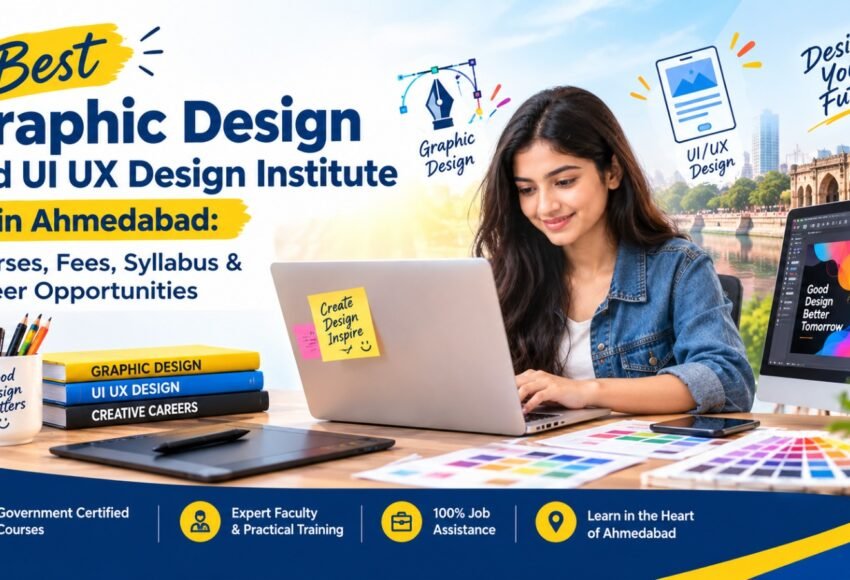
Best Graphic Design and UI UX Design Institute in Ahmedabad: Courses, Fees, Syllabus & Career Opportunities
Graphic Design and UI/UX Design are two popular creative fields that have become increasingly relevant in today’s digital environment. Businesses need attractive branding and visual communication, while websites, mobile applications and digital products require user-friendly interfaces and experiences.
For students in Ahmedabad, choosing the right design institute can make the learning process easier and more practical. A well-structured course should introduce students to design principles, professional tools, UI/UX workflows and real-world projects.
This guide explains what you should know about Graphic Design and UI/UX courses, including fees, syllabus, duration, skills, practical training and career opportunities.
Best Graphic Design and UI UX Design Institute in Ahmedabad: Courses, Fees, Syllabus & Career Opportunities
Introduction
Design has become an important part of almost every modern business.
From a company logo and social media post to a mobile application or website, design influences how people see, understand and interact with a brand.
This has created demand for professionals with skills in Graphic Design, UI Design and UX Design.
If you are a student, graduate, working professional or someone interested in creative careers, learning Graphic Design and UI/UX Design can be a useful way to develop both creative and technical skills.
Ahmedabad has several institutes offering creative design courses, making it important to understand what you should look for before joining one.
What Is Graphic Design?
Graphic Design is the process of communicating ideas and information through visual elements.
A graphic designer may create:
- Logos
- Posters
- Brochures
- Social media creatives
- Advertisements
- Business cards
- Packaging designs
- Banners
- Brand identity materials
- Digital marketing creatives
Graphic Design combines creativity with principles such as colour, typography, composition, spacing and visual hierarchy.
For beginners, learning these fundamentals is often more important than simply learning software.
What Is UI/UX Design?
UI and UX are related but different areas of digital product design.
UI Design
UI stands for User Interface.
UI designers focus on how a website, application or digital product looks and how users interact with its interface.
UI design can include:
- Buttons
- Menus
- Typography
- Colours
- Layouts
- Icons
- Forms
- Visual hierarchy
- Responsive interfaces
UX Design
UX stands for User Experience.
UX focuses on understanding users and creating experiences that are useful, understandable and easy to navigate.
UX activities can include:
- User research
- User personas
- User journeys
- Information architecture
- Wireframing
- Usability considerations
- Prototyping
- User testing
In simple words:
Graphic Design = visual communication
UI Design = interface appearance and interaction
UX Design = overall user experience
Why Learn Graphic Design and UI UX Together?
Graphic Design and UI/UX Design have different focuses, but they share several foundational skills.
Learning both can help students understand:
- Visual communication
- Typography
- Colour theory
- Layout
- Design hierarchy
- Digital interfaces
- User behaviour
- Prototyping
- Branding
- Digital product design
A combined course can therefore be useful for learners who want to explore different creative career paths.
It can also help students understand whether they are more interested in visual communication, interface design or user experience.
What Should a Graphic Design and UI UX Course Include?
Before enrolling, carefully check the syllabus.
A comprehensive course can include the following modules.
1. Design Fundamentals
Students should understand the basic principles behind good design.
Topics can include:
- Elements of design
- Principles of design
- Colour theory
- Typography
- Composition
- Balance
- Contrast
- Alignment
- Visual hierarchy
- Grids and spacing
These concepts form the foundation of both Graphic Design and UI Design.
2. Graphic Design
A Graphic Design module may cover:
- Logo design
- Branding
- Poster design
- Brochure design
- Social media design
- Advertisement design
- Digital banners
- Print design
- Brand identity
- Creative composition
Students should ideally complete practical assignments while learning these concepts.
3. Professional Design Software
A design course should provide practical exposure to relevant industry tools.
Depending on the institute and syllabus, this may include software used for:
- Image editing
- Vector design
- Page layout
- Digital illustration
- UI design
- Prototyping
Students should check the current software list before admission because tools and workflows can change over time.
4. UI Design
A UI Design module can cover:
- Interface layouts
- Typography for interfaces
- Colour systems
- Buttons and components
- Navigation
- Forms
- Mobile interface design
- Website interface design
- Responsive design
- Design systems
Students should learn how to create interfaces that are not only attractive but also clear and consistent.
5. UX Design
UX training can introduce students to:
- User research
- User personas
- User journeys
- Problem identification
- Information architecture
- User flows
- Wireframes
- Prototypes
- Usability
- User testing
This part of the course helps learners move beyond visual design and understand the user’s perspective.
6. Wireframing and Prototyping
Wireframes are simplified layouts that help designers plan a digital product before developing the final interface.
Prototypes can demonstrate how different screens connect and how users move through a website or application.
Students can practise creating:
- Website wireframes
- Mobile app wireframes
- User flows
- Interactive prototypes
- Landing page structures
- Application screens
7. Portfolio Development
A portfolio is one of the most important outcomes of a design course.
Instead of only showing certificates, students should ideally be able to demonstrate their actual work.
A beginner portfolio can include:
- Logo projects
- Branding projects
- Social media creatives
- Poster designs
- Website UI
- Mobile app UI
- UX case studies
- Landing page designs
A strong portfolio gives employers and clients something practical to evaluate.
Graphic Design and UI UX Course Fees in Ahmedabad
The fees for Graphic Design and UI/UX courses in Ahmedabad can vary significantly.
Factors affecting fees include:
- Course duration
- Number of modules
- Software training
- Classroom or online format
- Practical projects
- Portfolio support
- Certification
- Trainer experience
- Infrastructure
- Career assistance
Instead of selecting a course only because it has a low fee, compare what is included in the training.
Typical Fee Comparison Factors
| Factor | Why It Matters |
|---|---|
| Course Duration | Determines how much time is available for learning |
| Syllabus | Shows what skills you will actually study |
| Practical Training | Helps convert theory into skills |
| Projects | Provides portfolio material |
| Software | Builds technical design skills |
| Certification | Provides evidence of course completion |
| Portfolio | Helps demonstrate practical ability |
| Career Support | Can assist with job preparation |
Note: Course fees change between institutes and batches, so students should confirm the current fee structure directly before admission.
How Long Does a Graphic Design and UI UX Course Take?
Course duration depends on the depth of the curriculum.
Short-term programs may focus on specific tools or fundamentals, while comprehensive programs may cover Graphic Design, UI Design and UX Design together over a longer period.
When comparing duration, don’t look only at the number of months.
Check:
- Number of training hours
- Practical sessions
- Assignments
- Projects
- Portfolio work
- Revision sessions
- Trainer support
A longer course is not automatically better; the quality and relevance of the curriculum are also important.
Career Opportunities After Graphic Design and UI UX Training
After developing the required skills and portfolio, students can explore different creative and digital roles.
Possible career paths include:
Graphic Designer
Creates visual content for businesses, brands, advertising and digital media.
UI Designer
Designs the visual interface of websites, applications and digital products.
UX Designer
Works on user research, user flows, information architecture and overall user experience.
Visual Designer
Combines visual communication and digital interface design.
Brand Designer
Works on brand identity, visual systems and marketing materials.
Web Designer
Creates visual layouts and interfaces for websites.
Product Designer
Works across different stages of digital product design, combining UI and UX skills.
Freelance Designer
Designers can also work independently with businesses, agencies, startups and individual clients.
Who Can Join a Graphic Design and UI UX Course?
These courses can be suitable for:
- College students
- Graduates
- Beginners
- Creative professionals
- Digital marketing learners
- Freelancers
- Entrepreneurs
- Working professionals
- People changing careers
You do not necessarily need to be an advanced artist to begin.
Curiosity, creativity, willingness to practise and an interest in solving visual and user problems can be more important starting points.
What Should You Check Before Choosing a Design Institute in Ahmedabad?
With multiple institutes available, compare the following points before making a decision.
1. Check the Syllabus
Make sure the curriculum covers the skills you actually want to learn.
2. Look at Student Projects
Ask to see examples of completed student work where available.
3. Ask About Practical Training
Find out whether the course includes assignments and real-world-style projects.
4. Check Software Training
Understand which tools are included and whether the training is hands-on.
5. Ask About Portfolio Development
A course should ideally help you create work that you can present professionally.
6. Compare Fees
Look at the complete fee structure and what is included rather than comparing the headline price alone.
7. Check Course Timings
Students and working professionals may need weekday, weekend, morning or evening batches.
8. Understand Certification
Ask what certificate is provided and who issues it.
9. Check Career Support
If your goal is employment, ask about interview preparation, resume support, placement assistance and employer connections.
Graphic Design vs UI UX Design
| Graphic Design | UI/UX Design |
|---|---|
| Focuses on visual communication | Focuses on digital products and user experience |
| Logos and branding | Websites and applications |
| Posters and advertisements | Interfaces and user flows |
| Social media creatives | Wireframes and prototypes |
| Print and digital design | Digital product design |
| Typography and composition | Usability and interaction |
| Brand identity | User-centred design |
Both fields overlap in areas such as typography, colour, composition and visual hierarchy.
Graphic Design and UI UX: Which Skills Should Beginners Develop?
A beginner can build skills progressively.
Creative Skills
- Creativity
- Visual thinking
- Typography
- Colour selection
- Composition
Technical Skills
- Design software
- Digital illustration
- Image editing
- Vector design
- UI design tools
UX Skills
- User research
- Wireframing
- User flows
- Prototyping
- Usability
Professional Skills
- Communication
- Presentation
- Time management
- Client understanding
- Portfolio development
Why Ahmedabad Is a Useful Place to Learn Design Skills
Ahmedabad has a growing ecosystem of businesses, startups, agencies, educational institutions and digital service providers.
This creates opportunities for learners to explore different types of design work, including:
- Branding
- Advertising
- Social media
- Website design
- Digital marketing
- Mobile applications
- E-commerce
- Product design
For students, local classroom training can also provide opportunities for face-to-face interaction, feedback and collaborative learning.
Build a Portfolio While You Learn
One common mistake beginners make is waiting until the end of the course to start creating a portfolio.
Instead, build it gradually.
For example:
Project 1: Logo and brand identity
Project 2: Social media campaign
Project 3: Website landing page
Project 4: Mobile application UI
Project 5: UX case study
Project 6: Complete website redesign concept
This approach allows you to show your progress and demonstrate different skills.
Graphic Design and UI UX Course: Beginner Learning Roadmap
A simple learning path can look like this:
Step 1: Learn design fundamentals
↓
Step 2: Learn essential design software
↓
Step 3: Practise Graphic Design projects
↓
Step 4: Learn UI design principles
↓
Step 5: Understand UX research and user flows
↓
Step 6: Create wireframes and prototypes
↓
Step 7: Complete real-world-style projects
↓
Step 8: Build a professional portfolio
↓
Step 9: Prepare your resume and interview presentation
↓
Step 10: Apply for internships, jobs or freelance projects
FAQs
1. Which is better for beginners: Graphic Design or UI/UX Design?
Both can be suitable for beginners. Graphic Design focuses more on visual communication, while UI/UX focuses on digital interfaces and user experiences. Your choice can depend on your interests and career goals.
2. Can I learn Graphic Design and UI/UX together?
Yes. Many comprehensive design programs combine Graphic Design, UI Design and UX concepts to provide broader creative and digital design skills.
3. What is the eligibility for a Graphic Design and UI UX course?
Eligibility varies by institute. Many beginner-level courses are open to students, graduates and learners without previous professional design experience.
4. How much does a Graphic Design course cost in Ahmedabad?
Fees vary according to the institute, course duration, syllabus, training format, software and practical components. Always confirm the latest fee structure before enrolling.
5. Is UI/UX design a good career option?
UI/UX provides several career paths across digital products, websites, applications and other interactive experiences. Career opportunities depend on skills, portfolio quality, experience and the requirements of individual employers.
6. Do I need drawing skills to learn UI/UX?
Advanced drawing skills are not generally required to start UI/UX. UI/UX involves understanding users, layouts, interfaces, information and interactions.
7. Can I get a job after completing a Graphic Design and UI UX course?
A course can help build foundational skills, but employment also depends on your practical ability, portfolio, communication skills, experience and employer requirements.
8. What software should I learn for Graphic Design and UI/UX?
The software depends on the institute and career path. Students should choose training that provides hands-on experience with relevant current design and prototyping tools.
9. Is a certificate enough to get a design job?
A certificate can demonstrate course completion, but employers may also evaluate practical skills, portfolio projects, creativity, problem-solving and communication.
10. Can I work as a freelance Graphic or UI/UX Designer?
Yes. Designers can work on freelance projects for businesses, agencies, startups and individual clients. Building a strong portfolio and learning client communication can help when starting freelance work.
Conclusion
Choosing the right Graphic Design and UI UX Design institute in Ahmedabad is an important step for anyone planning to enter the creative and digital design industry.
Rather than selecting a course only based on fees or course duration, compare the syllabus, practical training, software exposure, projects, portfolio development, certification, batch timings and career support.
Graphic Design can help you build strong visual communication skills, while UI/UX Design can introduce you to digital interfaces, user research and product experiences. Learning both can give beginners a broader understanding of the modern design landscape.
If you are planning to join a design course in Ahmedabad, take time to compare institutes, review the curriculum and understand exactly what you will learn before making your decision.
The most valuable outcome of a design course is not just completing the classes—it is developing practical skills and a portfolio that demonstrates what you can create.