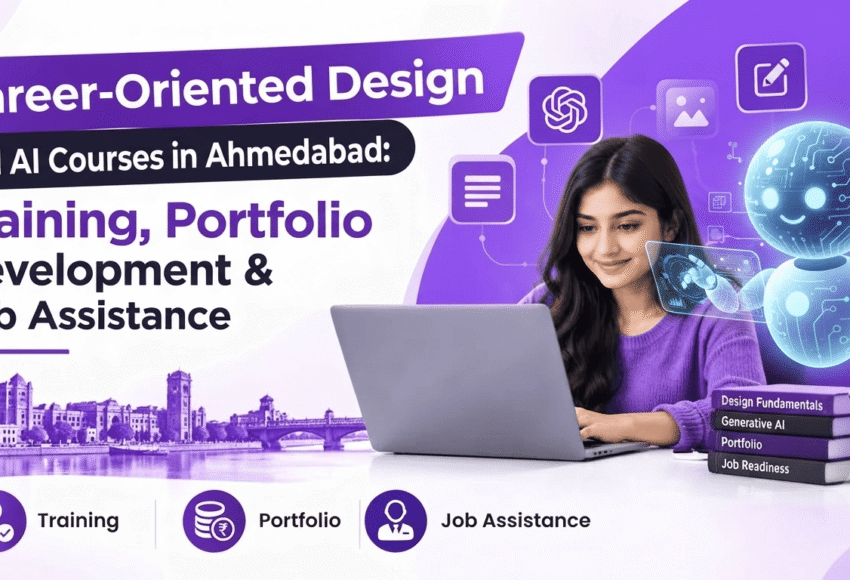
Career-Oriented Design and AI Courses in Ahmedabad, Training, Portfolio Development & Job Assistance
The creative and digital industries are increasingly combining design skills with technology and artificial intelligence. For students, graduates, beginners and working professionals in Ahmedabad, career-oriented Design and AI courses can provide a structured way to develop practical skills and build professional portfolios.
Courses such as Graphic Design, UI/UX Design, Multimedia, Animation, Video Editing and Creative AI can prepare learners for different types of digital and creative roles.
This guide explains what career-oriented training means, which skills learners can develop, how portfolio development works, the role of AI in creative careers and what to look for when choosing a training institute that offers career or job assistance.
What Are Career-Oriented Design and AI Courses?
Career-oriented courses are designed around practical skills that learners can apply to professional assignments, internships, freelance projects or entry-level jobs.
Instead of focusing only on theoretical concepts, these programs may combine:
- Practical training
- Professional software
- Realistic assignments
- Industry-style projects
- AI tools
- Portfolio development
- Presentation skills
- Interview preparation
- Resume development
- Career guidance
The exact curriculum depends on the course and training institute.
Why Combine Design and AI Skills?
Design and AI are increasingly connected.
A designer may use AI for brainstorming, image generation or creative variations. A video editor may use AI for transcription, subtitles or content workflows. A digital marketer may use AI for content research and campaign ideation.
However, AI tools work best when combined with fundamental skills.
A useful learning model is:
Creative Fundamentals + Professional Software + AI Tools + Practical Projects + Portfolio
This approach allows learners to understand not only how to use a tool, but also how to solve creative problems.
Popular Career-Oriented Design and AI Courses in Ahmedabad
Several courses can be considered depending on the learner’s career objective.
Graphic Design Course
Graphic Design focuses on visual communication, branding, advertising and digital content.
Typical syllabus
- Design fundamentals
- Colour theory
- Typography
- Composition
- Layout
- Logo design
- Branding
- Advertising design
- Social media creatives
- Image editing
- Adobe Photoshop
- Adobe Illustrator
- Adobe InDesign
- AI-assisted design
- Portfolio development
Practical projects
Students may work on:
- Logo design
- Brand identity
- Social media campaigns
- Posters
- Brochures
- Advertisements
- Product creatives
Career opportunities
Possible roles include:
- Graphic Designer
- Visual Designer
- Brand Designer
- Creative Designer
- Social Media Designer
- Junior Art Director
- Freelance Designer
UI/UX Design Course
UI/UX Design combines visual design with user experience and digital product thinking.
Typical syllabus
- UI design principles
- UX fundamentals
- User research
- User personas
- User journeys
- Information architecture
- Wireframes
- Prototypes
- Usability testing
- Responsive design
- Design systems
- Website design
- Mobile app design
- Figma
- Portfolio case studies
Practical projects
Learners may create:
- Website interfaces
- Mobile app interfaces
- E-commerce designs
- Landing pages
- Dashboard designs
- UX case studies
Career opportunities
Possible roles include:
- UI Designer
- UX Designer
- Product Designer
- Visual Designer
- Interaction Designer
- UX Research Assistant
Creative AI Course
Creative AI courses focus on applying generative AI and other AI tools to creative workflows.
Typical syllabus
Depending on the program, topics may include:
- AI fundamentals
- Generative AI
- Prompt writing
- AI image generation
- AI video generation
- AI-assisted graphic design
- AI content creation
- AI voice tools
- AI presentation tools
- Creative automation
- AI-assisted research
- AI workflow development
Practical AI projects
Learners could work on:
- AI advertising concepts
- AI-generated product visuals
- Social media campaigns
- AI-assisted videos
- AI storytelling
- Creative presentations
- AI content workflows
Because AI platforms evolve quickly, learners should check which tools are currently included in the syllabus.
Multimedia and Animation Courses
Multimedia programs can combine multiple creative disciplines.
Typical syllabus
- Graphic Design
- Digital illustration
- Animation
- Video editing
- Motion graphics
- 2D animation
- 3D fundamentals
- Visual effects
- Audio basics
- Filmmaking
- Digital storytelling
- AI-assisted creative workflows
Practical projects
Students may create:
- Animated videos
- Motion graphics
- Short videos
- Brand films
- Explainer videos
- Social media content
- Animation showreels
Career opportunities
Possible roles include:
- Multimedia Designer
- Animation Artist
- Motion Graphics Designer
- Video Editor
- Visual Content Creator
- VFX Artist
- Digital Media Designer
What Makes a Design or AI Course Career-Oriented?
Not every course with a professional-sounding title necessarily provides career-focused training.
A career-oriented program should ideally connect learning with practical application.
Practical Skill Development
Students should regularly use the tools and techniques taught in the course.
Project-Based Learning
Assignments should move beyond simple software exercises and involve realistic creative briefs.
Portfolio Development
Students should finish the program with selected work that demonstrates their capabilities.
Industry-Style Workflow
Learners should understand how a project moves from brief to research, creation, feedback, revision and final delivery.
Career Preparation
Training may include resume preparation, interview practice, portfolio presentation and professional communication.
AI Integration
Where relevant, students should learn how AI can be incorporated into creative workflows while maintaining quality and originality.
Why Portfolio Development Matters
A portfolio is one of the most useful ways for a creative learner to demonstrate practical ability.
Instead of only saying:
“I know Graphic Design.”
A portfolio allows the learner to show:
“Here are the designs I created.”
A Graphic Design portfolio may include:
- Logo designs
- Brand identity
- Posters
- Social media campaigns
- Advertising creatives
- Packaging
A UI/UX portfolio can include:
- Website designs
- Mobile apps
- Wireframes
- Prototypes
- UX case studies
An AI portfolio can include:
- AI-assisted campaigns
- AI-generated visual concepts
- AI video projects
- Creative workflows
- AI-assisted presentations
A multimedia portfolio can include:
- Animation
- Motion graphics
- Video editing
- Short films
- VFX projects
How to Build a Professional Portfolio During a Course
Portfolio development should ideally begin during training rather than after completing the course.
Start With Small Projects
Begin with simple assignments to understand the fundamentals.
Move to Realistic Briefs
Create projects based on realistic business requirements.
Complete End-to-End Projects
Take a project from research to final output.
Revise Your Work
Use trainer or peer feedback to improve the project.
Select Your Strongest Work
A portfolio does not need to contain every assignment.
Present the Process
For fields such as UI/UX, showing the problem, research, wireframes and final solution can help demonstrate the thinking behind the design.
Keep the Portfolio Updated
Add better work as your skills improve.
What Is Job Assistance?
Job assistance generally refers to services that help learners prepare for or find employment opportunities.
Depending on the institute, this may include:
- Resume preparation
- Portfolio review
- Interview preparation
- Mock interviews
- Job opportunity updates
- Employer connections
- Career counselling
- Placement drives
- Interview scheduling assistance
The exact services vary between institutes.
It is important to distinguish job assistance or placement support from a guaranteed job. Students should ask an institute to clearly explain what services are included.
What Should You Ask About Job Assistance?
Before enrolling, ask specific questions rather than relying only on phrases such as “100% placement.”
Useful questions include:
How are job opportunities shared with students?
Does the institute arrange interviews?
Is resume preparation included?
Is portfolio review provided?
Are mock interviews conducted?
Which types of companies recruit or interview students?
How long does career support continue after course completion?
Are there eligibility conditions for placement assistance?
Clear answers can help you understand what the advertised career support actually includes.
Design and AI Course Comparison
| Course | Main Focus | Practical Projects | Portfolio Type | Potential Career Areas |
|---|---|---|---|---|
| Graphic Design | Visual communication | Branding, ads, social media | Design portfolio | Design, branding, advertising |
| UI/UX | Digital product design | Websites, apps, UX case studies | UX/UI portfolio | Product and digital design |
| Creative AI | AI-assisted creative workflows | Images, videos, campaigns | AI creative portfolio | Creative technology, content |
| Animation | Motion and storytelling | 2D/3D, motion graphics | Showreel | Animation, media, advertising |
| Multimedia | Multiple creative skills | Video, design, animation | Multimedia portfolio | Digital media, content |
| Video Editing | Video post-production | Reels, ads, YouTube videos | Video showreel | Media, content, advertising |
How AI Is Changing Creative Training
AI can influence several stages of a creative project.
Research and Ideation
AI can help generate initial ideas and explore different creative directions.
Visual Development
Generative tools can assist with concept visuals and variations.
Video Production
AI can assist with scripting, subtitles, voice, editing and some video-generation workflows.
Content Creation
AI can help produce drafts and variations for digital content.
Workflow Automation
Repetitive tasks can sometimes be accelerated using AI-assisted workflows.
However, learners should still understand:
- Design principles
- Storytelling
- Brand guidelines
- User needs
- Visual hierarchy
- Editing
- Quality control
AI output still requires human review and creative direction.
Practical Training: From Classroom Exercise to Portfolio Project
A career-oriented course can follow a project workflow such as:
Brief → Research → Idea → Design → AI Assistance → Editing → Feedback → Revision → Final Project → Portfolio
For example, a student may receive a fictional business brief.
Project: Create a digital campaign for a new café.
The learner could:
- Research the target audience
- Develop a visual concept
- Create the brand identity
- Design social media creatives
- Generate supporting visuals with AI
- Create a promotional video
- Edit the final content
- Present the campaign
- Add the completed project to the portfolio
This approach connects multiple skills to a realistic project.
Online vs Classroom Career-Oriented Training
Both formats can provide career-focused learning when structured properly.
| Factor | Online | Classroom |
|---|---|---|
| Flexibility | Higher | Usually scheduled |
| Trainer interaction | Online | Face-to-face |
| Practical projects | Possible | Usually guided directly |
| Feedback | Online review | Direct review |
| Travel | Not required | Required |
| Suitable for | Flexible learners | Structured learners |
| Portfolio development | Depends on support | Can include direct guidance |
The quality of training, practical assignments and feedback can matter more than the delivery format alone.
Who Can Join Career-Oriented Design and AI Courses?
These courses can be relevant for:
- Students after 12th
- College students
- Graduates
- Beginners
- Career changers
- Working professionals
- Freelancers
- Content creators
- Entrepreneurs
- Social media professionals
- Aspiring designers
Eligibility requirements depend on the specific course.
Career Opportunities After Design and AI Training
After developing practical skills and a portfolio, learners can explore different career paths.
Design Careers
- Graphic Designer
- Visual Designer
- Brand Designer
- UI Designer
- UX Designer
Multimedia Careers
- Video Editor
- Motion Graphics Designer
- Animation Artist
- Multimedia Designer
- Content Creator
AI-Enabled Creative Careers
- AI-assisted Content Creator
- Creative AI Specialist
- AI Visual Content Creator
- AI-assisted Video Creator
Actual job titles vary by employer, and career progression depends on skills, experience, portfolio quality and specialization.
How to Choose a Career-Oriented Training Institute in Ahmedabad
Before joining, compare the following areas.
Course Syllabus
Check whether the syllabus matches your intended career.
Practical Training
Ask how much of the course involves hands-on work.
Projects
Request examples or a list of projects students complete.
Portfolio Development
Find out whether the institute provides structured portfolio guidance.
Software
Check whether relevant professional software is included.
AI Tools
Ask which AI tools are taught and how they are applied.
Trainers
Review trainer experience and professional background.
Certification
Understand what the certificate represents.
Job Assistance
Ask exactly what career services are provided.
Course Fees
Compare the total fee with the number of training hours, projects and services included.
Learning Format
Choose between online, classroom or hybrid learning based on your schedule and learning preferences.
Career-Oriented Learning Roadmap
A beginner can follow this progression:
Step 1: Choose a Career Area
Select Graphic Design, UI/UX, Multimedia, Animation, AI or a combination.
Step 2: Learn Fundamentals
Understand the basic principles of the selected field.
Step 3: Learn Professional Tools
Practice the software and AI tools relevant to your specialization.
Step 4: Complete Practical Assignments
Start with small exercises.
Step 5: Create Realistic Projects
Work on projects based on realistic briefs.
Step 6: Build Your Portfolio
Select and present your strongest projects.
Step 7: Improve Your Resume
Create a resume that highlights relevant skills and projects.
Step 8: Prepare for Interviews
Practice explaining your projects, tools and creative decisions.
Step 9: Explore Job Opportunities
Use institute support, professional networks, job platforms and direct applications.
Step 10: Continue Learning
Creative technology and AI tools change frequently, so continuous learning is useful.
Frequently Asked Questions
What are career-oriented design courses in Ahmedabad?
Career-oriented design courses focus on practical skills such as Graphic Design, UI/UX, Animation, Multimedia and digital content creation, with an emphasis on projects, portfolios and professional workflows.
Which AI courses are useful for creative careers?
Creative AI programs may cover generative AI, prompting, AI image generation, AI video, content creation, voice tools and creative workflow automation. The appropriate course depends on the learner’s career objective.
What is included in career-oriented design training?
It may include software training, practical assignments, real-world projects, portfolio development, presentations, resume preparation and career guidance.
Why is portfolio development important?
A portfolio allows students to demonstrate their actual creative work to employers and clients. It can be particularly important for design, UI/UX, animation and multimedia roles.
Do design institutes provide job assistance?
Some institutes offer services such as interview preparation, resume support, job updates, portfolio reviews, employer connections or placement drives. The exact services vary by institute.
Does job assistance guarantee a job?
No. Job assistance and placement support generally refer to career services and employment opportunities rather than a guaranteed employment outcome. Students should ask the institute for the exact terms.
Can beginners join Design and AI courses?
Yes. Beginner-level programs can start with fundamentals before moving into professional software, AI tools and practical projects.
Can I learn Graphic Design and AI together?
Yes. Graphic Design fundamentals can be combined with AI-assisted image generation, ideation, editing and creative workflows.
Can UI/UX designers use AI?
Yes. AI can assist with research, ideation, content generation and some design workflows. UI/UX fundamentals such as user research, usability and interaction design remain important.
Are online courses suitable for career development?
Online courses can support career development when they include structured instruction, practical assignments, feedback, projects and portfolio guidance.
What should I check before joining a design institute in Ahmedabad?
Compare the syllabus, trainers, practical projects, software, AI modules, portfolio support, course duration, fees, certification and job-assistance services.
Can a creative course help me become a freelancer?
Creative skills such as Graphic Design, UI/UX, video editing, animation and AI-assisted content creation can be used for freelance services after sufficient practice and portfolio development.
Conclusion
Career-oriented Design and AI courses can provide learners in Ahmedabad with a structured pathway from learning creative fundamentals to developing practical projects and building a professional portfolio.
Graphic Design, UI/UX, Multimedia, Animation and Creative AI each offer different skill sets and career possibilities. Combining traditional creative skills with appropriate AI tools can also help learners understand modern digital workflows.
When selecting a training institute, look beyond the course title or certificate. Compare the practical syllabus, projects, software, AI training, portfolio development, trainer experience, course duration, fees and job-assistance services.
A career-focused learning journey can follow this process:
Learn → Practice → Create Projects → Build Portfolio → Prepare for Interviews → Explore Opportunities → Continue Learning.
The goal should be to finish the course with not just a certificate, but demonstrable skills, relevant projects and a portfolio that communicates what you can actually do.